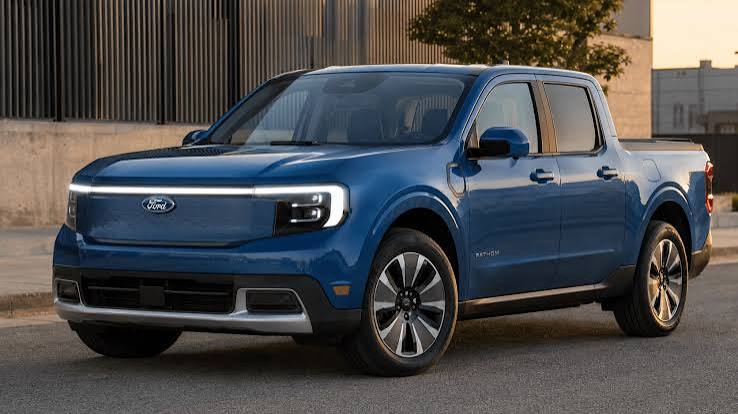
Ford is finally showing the world what its affordable electric-vehicle strategy looks like.
The company has officially unveiled the Ford Fathom, a new electric pickup designed to bring EV ownership into a price range that has been difficult for established automakers to reach.
The most important number is the price.
The Fathom starts at $28,350, before destination charges. With the $1,595 destination fee included, the starting price is $29,945.
That makes Ford’s new electric truck one of the most affordable EVs from a major established automaker.
And Ford isn’t planning to make it a stripped-down vehicle just to hit that price.
The Fathom is expected to offer seating for five, a large touchscreen, bidirectional charging capability, a digital key, Apple CarPlay and Android Auto, and hardware capable of supporting Ford’s BlueCruise driver-assistance system.
Production is scheduled to begin in 2027.
Here’s what we know so far.
The $30,000 Ford EV Finally Has a Name
For more than a year, Ford has been talking about a new affordable electric pickup without revealing its final name.
The company initially described it as the first vehicle to use its new Universal EV Platform.
Now we know what it will be called:
Ford Fathom.
Ford says the name was selected after a nine-month process involving hundreds of possibilities.
“Fathom” has several meanings, including a unit used to measure water depth and the idea of understanding something deeply.
It’s an unusual name for a Ford truck.
But it also signals that Ford isn’t trying to attach the vehicle to one of its traditional truck nameplates.
The Price Is the Big Story
Ford originally said the new electric pickup would target a starting price of around $30,000.
It has now managed to come in below that target.
The Fathom’s announced starting price is:
$28,350 before destination charges
or
$29,945 including the $1,595 destination charge.
That puts it only slightly above some conventional entry-level vehicles.
It is also around $45 cheaper than a 2026 Ford Maverick XL once destination charges are considered, according to Car and Driver.
That comparison is particularly interesting.
The Maverick is already one of America’s most affordable pickups.
Ford is now preparing to sell an electric alternative at almost the same starting price.
It Isn’t the Electric Maverick
It would be easy to assume that the Fathom is simply an electric version of the Maverick.
It isn’t.
The Fathom is being developed on Ford’s new Universal EV Platform, a completely different architecture designed specifically around affordable electric vehicles.
Ford describes the Fathom as a midsize pickup.
However, its dimensions are expected to be close to those of the compact Maverick.
That makes it a particularly interesting vehicle for buyers who want the usefulness of a pickup without moving into the size and price of a full-size truck.
Ford Says It Can Seat Five
Despite its relatively compact footprint, Ford says the Fathom will have enough passenger space for five people.
The company also says it will provide more passenger volume than a Toyota RAV4.
That’s an ambitious claim.
The Fathom is therefore being designed to work as more than a work truck.
Ford wants it to appeal to people who might use it for commuting during the week and family trips or recreational activities on weekends.
There Is a Front Trunk
Because the Fathom doesn’t have a conventional petrol engine under the hood, Ford can use the front area for additional storage.
The truck will have a frunk, giving owners another place to carry equipment.
Combined with the pickup bed, that should make the Fathom considerably more practical than a conventional sedan or crossover.
The Pickup Bed Is Still Important
Ford hasn’t released every dimension of the bed yet, so we shouldn’t pretend to know its exact capacity.
But the basic concept is straightforward.
The Fathom is designed to give owners both:
A passenger cabin
and
an open pickup bed.
That’s one of the reasons an affordable electric pickup could be so important.
Many EVs are designed primarily around passenger transportation.
A compact pickup can offer a different type of utility.
Ford Is Targeting More Than Traditional Truck Buyers
Ford says it spent years studying the type of customer it wanted for this truck.
That customer isn’t necessarily the traditional American pickup buyer.
Instead, Ford is targeting people who want flexibility.
Someone who needs a practical vehicle for everyday life but doesn’t necessarily need a huge truck.
That could include:
- Young families
- Small-business owners
- Outdoor enthusiasts
- Urban drivers
- Tradespeople
- First-time truck buyers
- EV buyers looking for utility
The relatively small footprint could make the Fathom particularly appealing to buyers who find full-size pickups excessive.
Performance Could Be Surprisingly Strong
Ford isn’t positioning the Fathom as a slow, stripped-down economy vehicle.
The company has previously said the truck is targeting acceleration comparable to a Mustang EcoBoost.
Current reporting puts Ford’s target at approximately 4.5 seconds to 60 mph.
That’s remarkably quick for an affordable pickup.
However, it’s important to emphasize that this is a target, not an independently verified production specification.
Ford has not yet released the complete final performance specifications.
Range Is Still a Big Question
This is one area where Ford has not provided all the information buyers want.
The Fathom will launch with a standard-range battery.
Ford has also indicated that a longer-range battery option is expected.
Recent reporting suggests the entry-level version will have less than 300 miles of range, but Ford has not yet published a final EPA range figure.
So we shouldn’t give readers a precise range number yet.
That should change as Ford gets closer to production.
Why Ford Is Keeping the Battery Relatively Small
This is actually an important part of the Fathom’s affordability strategy.
One of the easiest ways to make an EV expensive is to install a huge battery.
Batteries remain one of the most expensive components of an electric vehicle.
Ford’s strategy is therefore to reduce costs throughout the vehicle rather than simply building another large, expensive EV.
That includes the battery.
It also includes the manufacturing process.
Ford’s New Universal EV Platform
The Fathom is the first vehicle to use Ford’s new Universal EV Platform.
Ford says the architecture was developed specifically to make affordable EVs easier and cheaper to manufacture at scale.
The company wants the platform to support an entire family of electric vehicles.
That could eventually include:
- Pickup trucks
- SUVs
- Vans
- Smaller cars
Ford has described the platform as a flexible foundation for a new generation of affordable EVs.
Ford Is Changing How It Builds EVs
The platform isn’t the only innovation.
Ford has also developed a new manufacturing system designed to reduce the number of parts and simplify assembly.
Instead of relying entirely on the traditional moving assembly line approach, Ford says its new Universal EV Production System uses a different method of building the vehicle in major sections before bringing those sections together.
The objective is simple:
Build the vehicle faster, with fewer parts and lower costs.
And that is essential if Ford wants to sell an EV for around $30,000 without losing money on every vehicle.
Ford Learned a Difficult Lesson From Its First EVs
This new strategy didn’t appear out of nowhere.
Ford’s first generation of mass-market EVs included vehicles such as the Mustang Mach-E and F-150 Lightning.
But the economics proved difficult.
Ford subsequently said it was changing its strategy after lower-than-expected EV demand, high costs and changing regulations affected the business case for some larger electric vehicles.
The company has therefore shifted more of its pure-EV development toward smaller, affordable vehicles.
That’s where the Fathom comes in.
Ford Wants Affordable EVs to Become Profitable
This is perhaps the most important part of the Fathom story.
Ford isn’t simply trying to build a cheap electric truck.
It wants to build an affordable EV that can actually make money.
That’s much harder.
Ford has said its revised strategy is intended to put its Model e EV business on a path toward profitability by 2029.
The Universal EV Platform is a major part of that strategy.
LFP Batteries Will Help
Ford has also announced plans to produce advanced lithium-iron-phosphate (LFP) batteries at its BlueOval Battery Park Michigan facility as part of the wider affordable-EV programme.
LFP batteries can offer advantages in cost and durability compared with some other battery chemistries.
For a vehicle whose biggest selling point is affordability, battery cost matters enormously.
The Fathom Will Have Bidirectional Charging
One of the more interesting features is bidirectional power capability.
That means the Fathom won’t necessarily just consume electricity.
It can potentially send electricity back out to other equipment.
This could allow the truck to function as a large mobile battery.
Imagine taking it camping and using the truck’s battery to power equipment.
Or using it as backup power during an outage, depending on the specific implementation and available equipment.
That’s a feature that could make the Fathom much more useful than its price suggests.
Digital Key Is Also Included
Ford says the Fathom will support a digital key.
That means a compatible smartphone can potentially be used to unlock and operate the vehicle.
It’s another example of Ford trying to avoid the idea that an affordable EV has to feel cheap or technologically outdated.
Apple CarPlay and Android Auto Are Coming
Ford is also keeping support for both Apple CarPlay and Android Auto.
That’s worth mentioning because smartphone integration remains one of the most important everyday technologies in a modern vehicle.
Ford’s new approach also puts greater emphasis on Apple software integration, including Apple Maps.
BlueCruise Will Be Available
The Fathom will have the hardware required for Ford’s BlueCruise hands-free driver-assistance system.
However, buyers shouldn’t assume that full BlueCruise functionality will necessarily be included permanently in the base price.
Current reporting indicates that the hardware will be installed but the feature may be activated through a subscription or other paid arrangement.
That’s an important distinction.
The truck may technically be capable of the feature without giving every buyer unlimited access to it.
This Is Where the Fathom Gets Interesting
Think about what Ford is trying to achieve.
A truck costing around $30,000.
Five seats.
A pickup bed.
A frunk.
Electric power.
Bidirectional charging.
Digital key.
Modern infotainment.
Apple CarPlay.
Android Auto.
BlueCruise hardware.
And potentially very quick acceleration.
That is a lot of equipment for the price.
The challenge is whether Ford can actually manufacture it at scale without pushing the price significantly higher.
The $30,000 Price Is Not the Whole Story
There’s an important distinction between a vehicle starting at $29,945 and the average customer paying $29,945.
The starting price will be for the standard-range battery and base configuration.
Optional equipment will cost extra.
A longer-range battery is expected to cost more.
And features such as BlueCruise may involve additional costs.
So buyers should not assume a fully equipped Fathom will cost less than $30,000.
Still, getting the entry price below that psychological threshold is important.
The Fathom vs Ford Maverick
This could become one of the most interesting comparisons.
The 2026 Ford Maverick XL currently starts at $28,145, according to Ford.
That means the Fathom and Maverick are entering remarkably similar price territory.
But their powertrains are completely different.
The Maverick uses a conventional petrol engine or hybrid system.
The Fathom is fully electric.
For someone who drives mostly around town and has access to home charging, the Fathom could potentially offer lower energy and maintenance costs.
For someone who frequently travels long distances through areas without charging infrastructure, the Maverick may still be the easier choice.
The Fathom vs Tesla Cybertruck
The Cybertruck isn’t really a direct competitor.
It’s substantially larger, more expensive and aimed at a completely different buyer.
But the comparison demonstrates just how dramatically the electric pickup market could broaden.
The Fathom is essentially taking the opposite approach.
Instead of making an electric truck futuristic and expensive, Ford is trying to make it ordinary, practical and affordable.
That may ultimately be more important for mass adoption.
The Fathom vs Slate Truck
This is a much more direct comparison.
The Slate Truck is another affordable electric pickup targeting the sub-$30,000 market.
Ford’s advantage is its enormous manufacturing infrastructure and established dealer network.
Slate’s advantage is that it was designed from the beginning as a minimalist, low-cost EV.
The competition between these two vehicles could be fascinating.
If Ford can deliver significantly more equipment without sacrificing affordability, it could have a major advantage.
Why This Could Matter for EV Adoption
The biggest obstacle to mass EV adoption may not be technology.
It may be price.
Many electric vehicles remain considerably more expensive than comparable petrol-powered cars before incentives.
The Fathom attacks that problem directly.
Instead of asking customers to pay $50,000 or $60,000 for an electric vehicle, Ford is trying to bring the starting price down toward the level of ordinary mainstream vehicles.
That’s potentially much more important than another 1,000 horsepower electric supercar.
Affordable EVs Could Be More Important Than Luxury EVs
The EV industry has spent years demonstrating what electric powertrains can do.
We’ve seen:
- 1,000-horsepower EVs
- 300-mile-plus range
- Ultra-fast charging
- Luxury electric SUVs
- Electric performance cars
But none of those things automatically make EVs affordable.
The next major phase of the transition could therefore be about something much less glamorous:
Making electric cars cheap enough for ordinary people to buy.
That’s exactly where the Fathom fits.
What About Nigeria and Africa?
This is where the Fathom story becomes particularly relevant to GoGreenway.
A $30,000 electric pickup would still be expensive once imported into Nigeria because of shipping, taxes, duties and other costs.
So the U.S. starting price shouldn’t be interpreted as the likely Nigerian retail price.
But the underlying technology is important.
Affordable EV platforms could eventually make electric vehicles cheaper to produce globally.
And if manufacturers begin producing smaller EVs for emerging markets, prices could eventually fall.
Charging Will Still Be a Challenge
The Fathom’s affordability won’t solve Africa’s charging problem by itself.
For an EV to make sense, buyers need access to electricity and charging equipment.
That means the growth of affordable EVs needs to happen alongside investment in:
- Home chargers
- Public charging stations
- Workplace charging
- Reliable electricity
- Solar-powered charging
- Battery servicing
- EV technician training
This is why electric mobility is much bigger than simply replacing petrol cars with electric ones.
The Fathom Could Be a Bigger Deal Than It Looks
The most interesting thing about Ford’s new truck isn’t necessarily the truck itself.
It’s the platform underneath it.
If Ford succeeds in developing a profitable way to manufacture affordable EVs, the same technology could eventually produce an entire family of inexpensive electric vehicles.
Ford has already said the Universal EV Platform is intended to support vehicles ranging from vans and SUVs to much smaller vehicles.
The Fathom is simply the first.
When Can You Buy One?
Ford plans to begin production of the Fathom at its Louisville Assembly Plant in Kentucky in 2027.
Pre-orders are expected to open in early 2027, with customer deliveries planned for later in the year.
That means the vehicle is still some time away from reaching customers.
And there are still many specifications we don’t know.
Ford has not yet revealed all of the final battery, range, charging and towing figures.
Those details will be important.
GoGreenway Verdict
The Ford Fathom could become one of the most important electric vehicles Ford has launched in years.
Not because it’s the fastest.
Not because it has the biggest battery.
And certainly not because it is the most luxurious.
Its importance comes down to one thing:
Price.
At $28,350 before destination charges, or $29,945 including destination, Ford has managed to keep its new electric pickup below the $30,000 mark.
That’s exactly where the EV market needs more competition.
The Fathom also appears to be more than a cheap truck.
It will offer five-seat capacity, a pickup bed, a frunk, bidirectional charging, digital-key technology and modern smartphone integration.
Its expected performance is also impressive, although we need to wait for production specifications and independent testing before judging those claims.
The biggest unanswered questions are range, real-world efficiency, charging speed, towing capacity and what a realistically equipped truck will cost.
Those figures will determine whether the Fathom is merely an inexpensive EV or a genuinely compelling electric pickup.
For now, though, Ford appears to have identified the right problem.
The EV industry doesn’t necessarily need more expensive electric vehicles.
It needs better, simpler and more affordable ones.
If Ford can deliver the Fathom at close to its promised price without compromising too much on quality or capability, this small electric pickup could be far more important to the EV market than many of today’s much more expensive electric trucks.
Sources
- Ford — Universal EV Platform and affordable electric pickup announcement
- Ford — Fathom name and latest details
- Reuters — Ford Fathom pricing and affordable-EV strategy
- Car and Driver — Ford Fathom price and specifications
- Edmunds — Ford’s $30,000 electric truck details