The race to build electric vehicles in the United States is increasingly becoming a race to control the batteries that power them.
That is why Hyundai Motor Group and SK On’s roughly $5 billion battery partnership in Georgia is so significant.
The project is designed to produce batteries close to Hyundai Motor Group’s growing U.S. vehicle manufacturing operations, helping Hyundai, Kia and Genesis secure a more local supply of battery cells for electric vehicles.
The planned facility in Bartow County, Georgia, is expected to have annual battery-cell production capacity of 35 GWh, enough to support approximately 300,000 electric vehicles per year.
But this isn’t simply a story about another battery factory.
It is part of a much larger shift in how automakers are building EVs.
Why Hyundai needs batteries in America
For years, automakers relied heavily on global supply chains for batteries and battery materials.
That worked reasonably well when electric vehicles represented a relatively small part of the market.
But as EV production grows, relying on batteries shipped from distant manufacturing hubs becomes more complicated.
There are transportation costs.
There are geopolitical risks.
There are trade policies.
And increasingly, there are government incentives for manufacturers that build components domestically.
Hyundai’s strategy is therefore moving toward producing vehicles and batteries closer to the American market.
The partnership with SK On
Hyundai Motor Group and SK On announced their battery-cell joint venture in April 2023.
The two companies planned to invest approximately $5 billion, with Hyundai Motor Group and SK On each holding a 50% stake.
The facility was planned for Bartow County, Georgia, placing it relatively close to Hyundai’s existing and expanding U.S. manufacturing operations.
The location is important.
The battery plant isn’t being built in isolation.
It is part of a larger manufacturing ecosystem.
The factory is designed to produce 35 GWh of batteries
The planned annual capacity of 35 GWh is substantial.
Hyundai says that would be enough to support the production of around 300,000 all-electric vehicles annually.
To put that into perspective, that’s potentially enough battery capacity to support hundreds of thousands of EVs every year.
The cells can then be assembled into battery packs by Hyundai Mobis and supplied to Hyundai Motor Group’s U.S. vehicle manufacturing facilities.
That creates a more integrated supply chain:
Battery cells → battery packs → vehicle assembly → finished EV
all within the broader U.S. manufacturing network.
Hyundai isn’t doing this alone
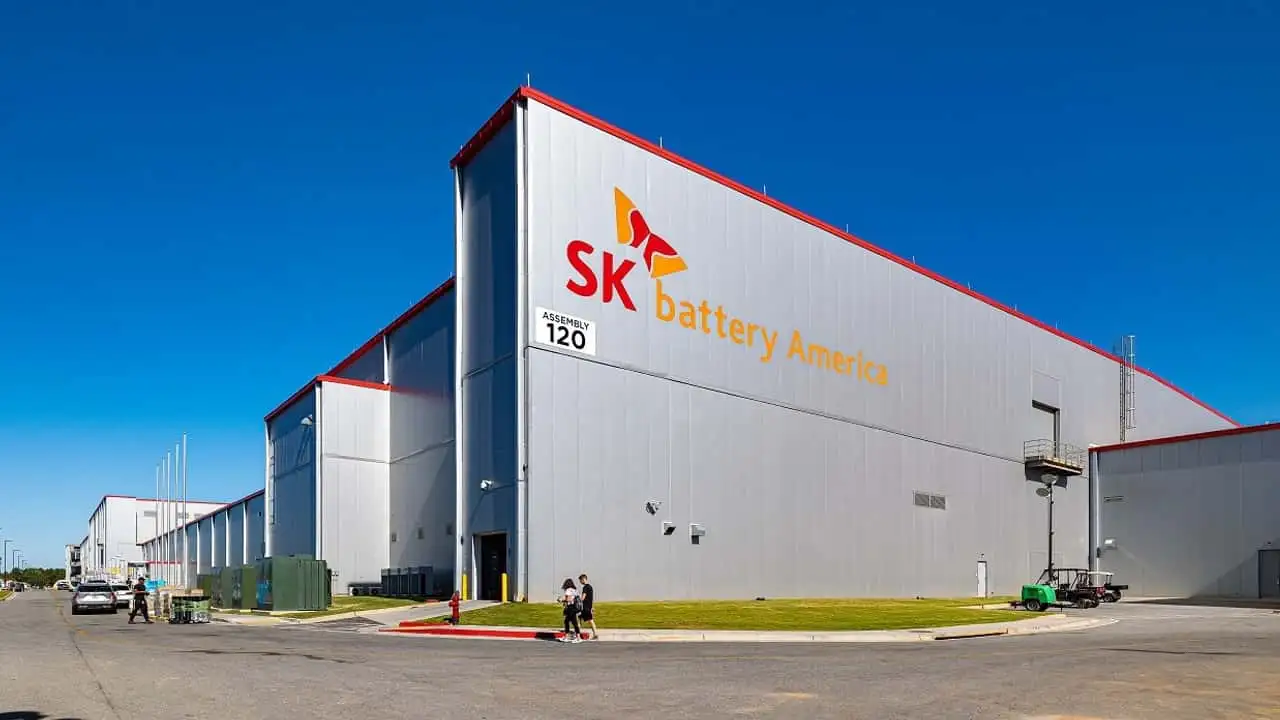
SK On is a major battery manufacturer and already has a presence in Georgia.
The company operates SK Battery America facilities in Commerce, Georgia, and had already established a workforce in the state before the Hyundai partnership was announced.
That existing presence helped make Georgia an attractive location for the partnership.
The state already had an emerging EV manufacturing ecosystem.
Hyundai was adding another major piece.
Georgia is becoming an EV manufacturing hub
The battery project is only one part of Hyundai’s investment in Georgia.
In 2022, Hyundai Motor Group announced a $5.54 billion investment in its Metaplant America facility in Bryan County.
The project was designed as a dedicated EV and battery manufacturing complex and was originally expected to create more than 8,100 jobs.
Georgia says the Metaplant celebrated its grand opening in March 2025, marking the completion of what the state describes as the largest economic-development project in its history.
That gives Hyundai a significant manufacturing footprint in the state.
The battery factory and vehicle factory work together
This is where the strategy becomes particularly interesting.
Instead of importing batteries into America and then building cars, Hyundai can increasingly create a local production chain.
The basic concept looks like this:
Raw materials → battery cells → battery packs → EV production → U.S. customers
That can reduce dependence on overseas battery supply.
It can also give Hyundai greater control over production.
Why battery supply is so important
The battery is arguably the most expensive and strategically important component of an electric vehicle.
If an automaker doesn’t have enough battery cells, it can’t build enough EVs.
It doesn’t matter how efficient the vehicle assembly plant is.
No batteries means no electric cars.
That makes battery manufacturing capacity a strategic asset.
The EV supply chain is becoming a competitive weapon
Tesla demonstrated the importance of controlling battery supply early in the EV industry.
Chinese automakers have also built enormous battery manufacturing capacity.
Companies such as CATL and BYD have become major players in the global battery industry.
Now traditional automakers are responding.
Hyundai’s partnership with SK On is part of that response.
The U.S. wants more battery production
There is also a political and economic reason for these investments.
The United States wants to reduce its dependence on foreign supply chains for critical technologies.
Batteries are one of them.
Lithium-ion batteries require materials and manufacturing capabilities that are distributed across multiple countries.
Building production capacity inside the United States gives American-based automakers a greater degree of supply-chain security.
The Inflation Reduction Act changed the calculation
U.S. policy has also encouraged domestic EV and battery manufacturing through incentives and requirements surrounding clean-energy investments.
The exact value of incentives available to a particular project can depend on several factors, including production levels, sourcing requirements and eligibility.
But the overall effect has been significant:
Building batteries in America has become more strategically attractive.
That has encouraged billions of dollars in investment across the U.S.
Hyundai’s investment extends beyond one factory
Hyundai Motor Group’s Georgia strategy has grown substantially since the original announcement.
Georgia reported that Hyundai’s planned investment in the state had reached more than $12.6 billion, with approximately 12,000 direct, long-term jobs associated with the group’s investments there as of 2024.
That includes multiple projects rather than just the SK On battery facility.
The result is effectively an EV manufacturing ecosystem.
Why build the battery factory near vehicle plants?
Distance matters.
Transporting battery cells isn’t necessarily impossible, but batteries are heavy and valuable.
Producing them closer to the vehicle factory can simplify logistics.
It can also reduce transportation requirements and potentially make production more responsive to vehicle demand.
The Hyundai-SK On project is located near Hyundai Motor Group’s U.S. production facilities, including its Alabama plant, Kia Georgia and the Metaplant America.
That proximity is a major part of the project’s logic.
It could help Hyundai produce more EVs
Battery availability can become a production bottleneck.
If demand for an electric SUV suddenly increases, the automaker needs enough battery cells to build those vehicles.
Local production provides another source of capacity.
That doesn’t guarantee unlimited production.
But it gives Hyundai greater flexibility.
The factory could support several brands
Hyundai Motor Group isn’t just Hyundai.
The group also includes Kia and Genesis.
The battery supply from the joint venture is intended to support the group’s U.S. EV production, potentially giving multiple brands access to locally produced cells.
That makes the investment more strategically important than a factory dedicated to a single model.
Hyundai has ambitious EV plans
Hyundai has been expanding its electric vehicle lineup with models such as the:
- IONIQ 5
- IONIQ 6
- IONIQ 9
- Kia EV6
- Kia EV9
- Genesis GV60
- Electrified GV70
A larger domestic battery supply can support that wider product strategy.
But the EV market is changing
There’s an important caveat.
Automakers around the world have had to adjust their EV strategies as consumer demand, incentives, regulations and market conditions have changed.
Some manufacturers have slowed or changed planned EV investments.
That doesn’t make battery production irrelevant.
It means companies have to be careful about matching production capacity with actual demand.
Battery factories are expensive bets
A multibillion-dollar battery plant isn’t a small investment.
The facility has to operate at sufficient utilisation to justify its construction and operating costs.
If EV demand grows rapidly, the factory can become a valuable asset.
If demand grows more slowly than expected, manufacturers can face excess capacity.
That’s one reason battery investments need to be considered as long-term industrial strategies rather than short-term EV sales bets.
Georgia benefits from the investment too
For Georgia, this is much more than an automotive story.
Large industrial projects create demand for:
- Construction workers
- Engineers
- Technicians
- Logistics companies
- Equipment suppliers
- Maintenance services
- Energy infrastructure
- Training programmes
The state initially estimated the Hyundai-SK On project would create more than 3,500 jobs through approximately $4–5 billion in investment.
The broader Hyundai ecosystem is expected to generate considerably more economic activity.
It also creates an EV supply-chain cluster
Once one major battery factory arrives, other companies have an incentive to locate nearby.
They may supply:
- Battery components
- Electrical systems
- Chemicals
- Packaging
- Manufacturing equipment
- Logistics
- Recycling services
That creates a cluster.
And clusters can become self-reinforcing.
Battery recycling could become part of the ecosystem
There’s another opportunity that isn’t always discussed when new battery factories are announced.
Eventually, large numbers of EV batteries will reach the end of their first vehicle life.
Those batteries contain valuable materials.
A mature EV manufacturing region could therefore eventually develop a circular supply chain:
Battery production → vehicle use → battery collection → recycling → recovered materials → new batteries
That could reduce the industry’s dependence on virgin raw materials over time.
This matters for the environmental side of EVs
Building a battery factory doesn’t automatically make electric cars environmentally friendly.
Battery production consumes energy and raw materials.
The environmental performance of the factory depends partly on how that energy is generated and how efficiently materials are used.
But local manufacturing can create opportunities for tighter control over production standards.
It can also make recycling and supply-chain transparency easier to integrate into the regional manufacturing ecosystem.
The factory could also help reduce transportation emissions
Battery cells are heavy.
Shipping them around the world adds transportation emissions and costs.
Manufacturing batteries closer to vehicle assembly can shorten some parts of the supply chain.
It doesn’t eliminate transportation.
Raw materials still have to reach the factory.
But it can reduce the distance between battery production and final vehicle assembly.
The bigger story is supply-chain localisation
Perhaps the most important lesson from Hyundai and SK On’s project is that the EV transition isn’t just about replacing petrol engines with electric motors.
It is also about rebuilding the industrial system behind automobiles.
For decades, car companies developed global supply chains around engines, transmissions and fuel systems.
EVs require different components.
The battery becomes central.
And companies are now competing to establish secure battery supply chains.
China currently dominates much of the battery industry
China has developed enormous battery manufacturing capacity.
Chinese companies have significant positions across battery cells, components, processing and raw materials.
That has made battery supply a strategic issue for Western automakers.
Hyundai’s investment in American battery production therefore has implications beyond its own vehicle lineup.
It’s part of a broader attempt to establish alternative supply chains.
SK On gives Hyundai an experienced battery partner
Hyundai doesn’t have to develop every part of the battery manufacturing process itself.
SK On brings battery manufacturing expertise and an existing relationship with Hyundai.
The companies already work together on batteries used in vehicles including the Hyundai IONIQ 5, Kia EV6 and Genesis GV60.
That reduces some of the risks associated with entering battery manufacturing alone.
The project also fits Hyundai’s “local production” strategy
There’s a broader principle behind the investment:
Build closer to where you sell.
If North America becomes a major market for Hyundai’s EVs, manufacturing batteries in North America makes strategic sense.
It can help the company respond to local demand and navigate changing trade policies.
What does this mean for EV buyers?
For consumers, a battery factory doesn’t immediately change the driving experience.
You won’t necessarily notice whether your IONIQ 5 battery was produced in Georgia or elsewhere.
But it can have indirect effects.
A more secure battery supply could help Hyundai increase production.
More production can potentially support greater EV availability.
And local manufacturing can help automakers meet regional sourcing requirements tied to incentives.
It could also help make EVs more mainstream
One of the biggest challenges facing EV adoption is scale.
Electric vehicles need to move from being relatively specialised products to mainstream transportation.
That requires enormous manufacturing capacity.
You need:
Cars.
Batteries.
Chargers.
Technicians.
Parts.
Software.
Recycling.
Energy infrastructure.
Hyundai’s Georgia investments address several pieces of that puzzle simultaneously.
There is a lesson here for Africa
This story is particularly relevant to African countries watching the global EV transition.
Africa has traditionally imported a large proportion of its vehicles.
That means much of the value created by vehicle manufacturing happens outside the continent.
But the EV transition creates a potential opportunity.
Instead of waiting until the global EV industry is completely mature, African countries could build capabilities around:
- EV assembly
- Battery-pack assembly
- Charging equipment
- Solar charging
- Battery recycling
- Fleet electrification
- Electric buses
- Two- and three-wheelers
The Hyundai-SK On project shows what happens when battery production becomes part of a broader industrial strategy.
Nigeria could learn from this model
Nigeria doesn’t necessarily need to replicate a $5 billion battery factory.
The country’s EV market and industrial base are very different from Georgia’s.
But there are smaller opportunities.
Battery-pack assembly could potentially be developed before full cell manufacturing.
Electric buses could create demand at scale.
Local charging infrastructure could support fleets.
Battery recycling could become a growing industry.
And renewable energy could support charging infrastructure.
The battery value chain is much bigger than the battery itself
A successful EV industry needs an ecosystem.
That includes:
Mining and raw materials
↓
Material processing
↓
Battery cells
↓
Battery packs
↓
Vehicle assembly
↓
Charging
↓
Vehicle servicing
↓
Battery reuse
↓
Battery recycling
Countries that participate in more parts of this chain can capture more economic value.
But battery manufacturing isn’t easy
It requires:
- Large capital investment
- Reliable electricity
- Highly trained workers
- Strict quality control
- Sophisticated equipment
- Chemical-processing expertise
- Strong supply chains
- Environmental safeguards
That’s why relatively few companies can manufacture batteries at enormous scale.
The long-term question is utilisation
The biggest question for Hyundai and SK On isn’t simply whether they can build the factory.
It’s whether they can keep it busy.
If Hyundai’s EV production grows strongly in North America, 35 GWh of annual capacity could become extremely valuable.
If demand develops more slowly, the economics become more challenging.
That makes the project’s integration with Hyundai’s wider U.S. manufacturing strategy particularly important.
This is bigger than one battery plant
Hyundai’s Georgia investment demonstrates something important about the EV transition.
The shift from petrol to electric isn’t happening only inside the vehicle.
It is happening in factories, supply chains, energy systems and industrial policy.
The companies that successfully navigate all of those areas could have a major advantage in the next phase of the automotive industry.
GoGreenway’s verdict
Hyundai and SK On’s approximately $5 billion Georgia battery partnership is much more than another EV factory announcement.
The planned 35 GWh annual battery-cell capacity could support batteries for around 300,000 electric vehicles a year, giving Hyundai Motor Group a major local source of battery supply for its growing U.S. EV manufacturing operations.
The project also sits within a much larger Hyundai investment strategy in Georgia.
The state’s Metaplant America has already become a major manufacturing operation, while Hyundai’s broader planned investments in Georgia have grown to more than $12.6 billion, according to the Georgia Department of Economic Development.
The significance goes beyond Hyundai.
It shows how the EV race is increasingly becoming a race for battery manufacturing capacity, local supply chains and industrial expertise.
For the United States, that means more domestic battery production.
For Hyundai, it means greater control over a critical component.
For Georgia, it means jobs and a growing EV manufacturing ecosystem.
And for the global EV industry, it is another sign that the battery is no longer just a component of an electric car.
It is becoming one of the most important pieces of the automotive industry itself.
Sources
- Hyundai Motor Group — official announcement of the SK On joint venture: confirms the approximately $5 billion investment, 50/50 ownership, 35 GWh capacity and planned supply to Hyundai/Kia/Genesis plants.
- Georgia Department of Economic Development — Bartow County announcement: confirms the location, investment range and expected jobs.
- Georgia Department of Economic Development — Hyundai Metaplant: provides the latest overview of Hyundai’s broader Georgia manufacturing investment and the 2025 Metaplant opening.
- Georgia Department of Economic Development — Hyundai investment: documents the broader $12.6+ billion Hyundai investment in Georgia.