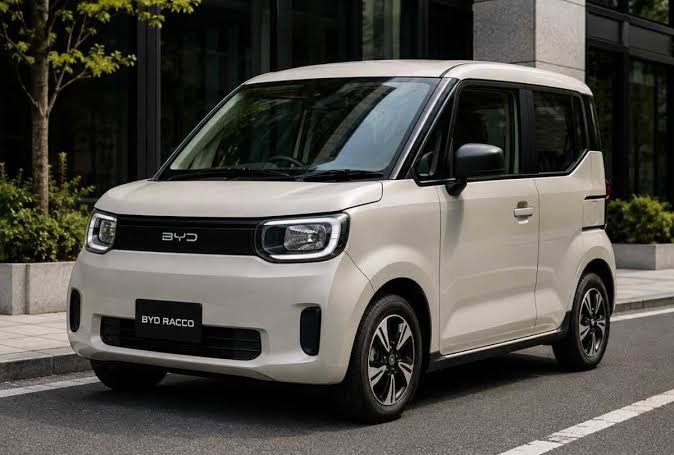
BYD has recorded more than 1,000 orders for its new Racco electric kei car in Japan just two weeks after the vehicle went on sale, giving the Chinese automaker an encouraging early result in one of the world’s most established small-car markets.
The Racco went on sale in Japan on July 28, and BYD Auto Japan said orders had passed 1,000 units within two weeks. The company later reported that total orders had reached 1,002 units by August 9, putting the model on its fastest initial sales pace among BYD’s vehicles launched in Japan.
The number is not large compared with the sales volumes of Japan’s biggest carmakers. But the Racco is important because BYD is entering the Japanese kei-car market with a vehicle specifically designed around the country’s small-car regulations and urban driving needs.
Why the Racco matters to BYD
Japan is a difficult market for foreign automakers, particularly in the small-car segment.
Kei cars are deeply established in Japan, with domestic manufacturers such as Suzuki, Daihatsu, Honda and Nissan having decades of experience building vehicles for Japanese drivers.
BYD is therefore not simply bringing another Chinese electric vehicle into the country. The Racco is an attempt to compete directly within a vehicle category that Japanese consumers already understand and use extensively.
That strategy could be important for BYD because the company has struggled to gain the same level of traction in Japan that it has achieved in several other international markets.
The Racco gives BYD a product designed around a very specific Japanese need: a compact vehicle that is easy to use in crowded urban environments while still providing the benefits of electric propulsion.
The Racco is small by design
The Racco is approximately 3.4 metres long and 1.5 metres wide, keeping it within Japan’s kei-car dimensions.
That compact footprint is more than a styling decision.
Small cars can be particularly useful in cities where parking spaces are limited and streets can be narrow. A smaller vehicle also requires less road space and can be easier to manoeuvre through congested areas.
BYD has also designed the Racco with practicality in mind. One of its notable features is a power-sliding rear door, a feature that can be particularly useful when passengers are getting in and out in tight parking spaces.
The result is an EV that focuses less on maximum size and more on making a relatively small footprint useful.
Three versions are available
The Racco is sold in Japan in three versions: the Racco 200, Racco 300 Plus and Racco 300 Premium.
According to BYD Japan’s current specifications, the two higher versions use a 35.84-kWh lithium-iron-phosphate (LFP) battery and have a claimed 320-km WLTC range.
The entry-level Racco 200 uses a 22.40-kWh battery and has a claimed 210-km WLTC range. All three versions use a front-mounted permanent-magnet synchronous motor producing 47 kW (64 PS) and 160 Nm of torque.
| Version | Battery | Claimed WLTC range | Japan price |
|---|---|---|---|
| Racco 200 | 22.40 kWh | 210 km | ¥2,145,000 |
| Racco 300 Plus | 35.84 kWh | 320 km | ¥2,398,000 |
| Racco 300 Premium | 35.84 kWh | 320 km | ¥2,497,000 |
Prices shown are BYD Japan’s manufacturer suggested retail prices including tax.
The official figures are worth highlighting because the Racco demonstrates that an urban EV does not necessarily need a huge battery.
The 22.4-kWh battery in the entry model is considerably smaller than the batteries found in many modern electric SUVs. That helps keep the vehicle compact and potentially reduces the amount of battery material required.
Most early buyers are choosing the expensive version
One of the more interesting details from the first two weeks is not simply how many Raccos were ordered, but which version buyers selected.
BYD says about 80% of the orders were for the top-spec Racco 300 Premium. The company also reported that the 300 Plus accounted for around 14% of orders, while the entry-level Racco 200 represented roughly 6%.
That is an interesting result.
If buyers were primarily looking for the cheapest possible electric kei car, the entry-level model might be expected to dominate. Instead, early customers have overwhelmingly chosen the more expensive version.
One possible explanation is the combination of additional equipment and the larger battery’s 320-km claimed range.
It is still too early to draw a definitive conclusion from two weeks of orders, but the early sales mix suggests that at least some Japanese buyers are willing to pay more for a better-equipped small EV.
BYD has a much bigger target
The 1,000-order milestone is only the beginning of BYD’s plan.
The company is targeting 10,000 Racco orders by the end of 2026. Reaching 1,002 orders within the first two weeks means the model has already reached roughly one-tenth of that target.
However, the pace will need to be sustained.
New vehicles often attract considerable attention immediately after launch, particularly when they enter a new market segment. The more meaningful test will come later, when the initial curiosity fades and BYD has to continue attracting customers through its dealerships, pricing, product reputation and after-sales support.
That is why the next several months could be more important than the first two weeks.
The Racco is not entering an empty market
BYD still faces strong competition.
Japanese manufacturers have long dominated the kei-car category, and electric alternatives already include models such as the Nissan Sakura and Mitsubishi eK X EV.
This gives Japanese consumers plenty of reasons to remain with established domestic brands.
BYD therefore needs to convince buyers that the Racco offers something compelling enough to overcome the advantage of familiarity.
Price is one part of that equation. The Racco starts at ¥2.145 million including Japanese consumption tax, while the higher versions remain below ¥2.5 million before any applicable incentives.
But price alone will not determine whether the vehicle succeeds. Reliability, servicing, dealer support, charging convenience and long-term resale value will also matter.
Charging is designed around everyday use
The larger-battery Racco can accept DC fast charging, and BYD Japan says the 300 Plus and 300 Premium can theoretically recover their battery from 30% to 80% in about 24 minutes using a 90-kW charger.
BYD also says the Racco supports Japan’s CHAdeMO rapid-charging standard.
For a vehicle intended primarily for urban use, that combination of a relatively small battery and reasonably quick charging could be more practical than carrying a much larger battery that many owners rarely need.
Of course, real-world charging times and range will vary depending on temperature, traffic, driving style, battery condition and charging equipment.
What the Racco says about the future of small EVs
Perhaps the most interesting lesson from the Racco is that the future of electric mobility may not be dominated entirely by large electric SUVs.
A smaller EV can require a smaller battery, consume less energy and take up less physical space.
For urban drivers who mainly travel relatively short distances, a compact EV with a 200- to 320-km rated range could make more sense than paying for a much larger vehicle and battery.
Japan’s kei-car market is an extreme example of this idea, but the underlying concept has wider relevance.
Cities around the world are dealing with congestion, limited parking and rising vehicle costs. That creates a potential role for smaller electric vehicles designed around everyday urban journeys rather than long-distance travel.
Could the Racco concept work in Nigeria?
The Racco itself is designed for Japan’s kei-car regulations, so it should not automatically be viewed as a ready-made solution for Nigeria.
Nigerian road conditions, vehicle preferences, import costs, charging infrastructure, service availability and electricity reliability are very different from those in Japan.
But the idea behind the Racco is worth watching.
Nigeria’s automotive market has a large need for vehicles that are affordable to buy and inexpensive to operate. A compact EV with a relatively small battery could potentially reduce energy and vehicle costs for some urban drivers if the necessary charging and maintenance infrastructure develops.
The bigger question is whether automakers can develop electric vehicles specifically for African conditions rather than simply importing models designed for completely different markets.
That is where the Racco offers an interesting lesson: local market requirements can influence the design of an EV just as much as battery technology does.
GoGreenway’s take
BYD’s first 1,002 Racco orders in Japan do not prove that the company has conquered the Japanese market.
They do, however, provide an encouraging start.
The more interesting story is not simply that BYD sold 1,000 small EVs. It is that the company has chosen to compete in Japan by adapting its product to a vehicle category that is deeply embedded in the country’s automotive culture.
The early preference for the 300 Premium is also worth watching. If that trend continues, it could suggest that buyers are willing to pay more for additional equipment and range even in a market built around affordable compact cars.
For BYD, the real challenge now is maintaining momentum and reaching its 10,000-order target.
For the wider EV industry, the Racco offers another reminder: electric mobility does not always need to mean bigger batteries, larger vehicles and longer range. Sometimes, the smarter EV may simply be the one that is designed for the journey people actually make.