Kia has finally given one of its most popular SUVs the powertrain many buyers have been waiting for.
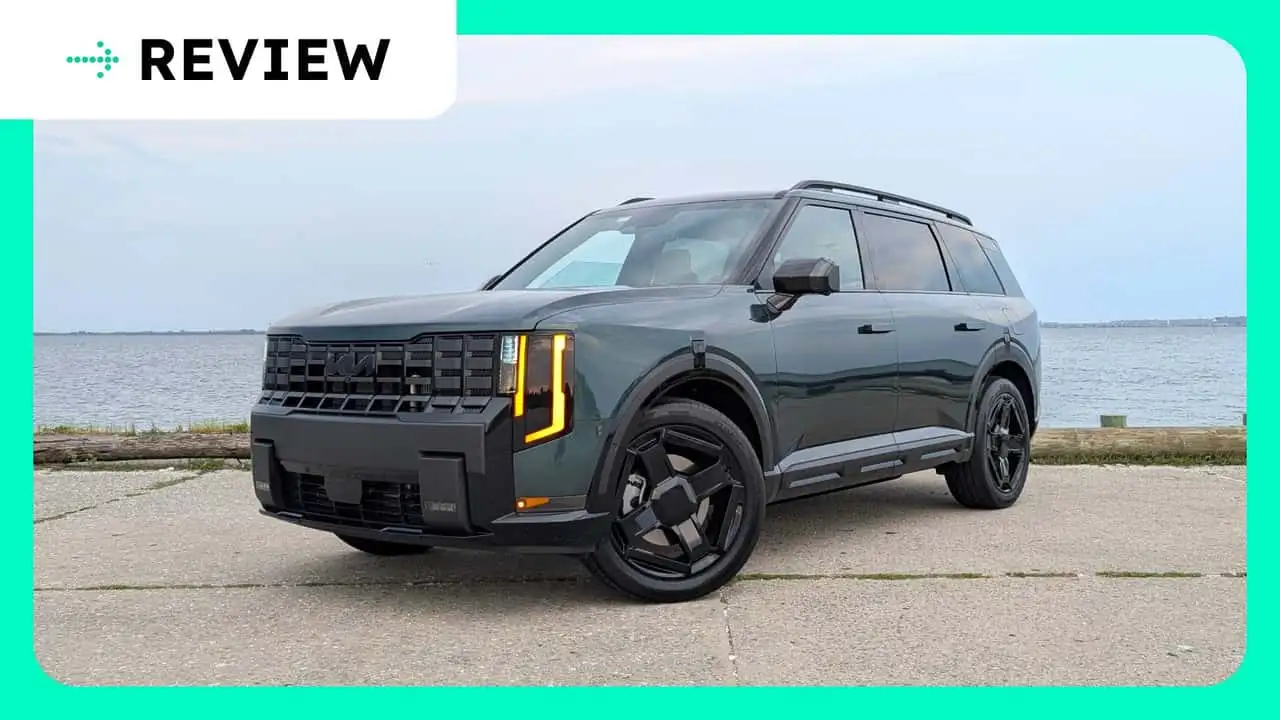
The redesigned 2027 Kia Telluride is now available with a hybrid system, bringing more power, better fuel economy and several clever electrified features to Kia’s three-row family SUV.
And after driving the new Telluride Hybrid, there’s an interesting conclusion to draw.
The Telluride Hybrid is one of the most convincing large family hybrids you can buy.
But it also makes Kia’s fully electric EV9 look even more impressive.
That’s not necessarily a bad thing for Kia.
Instead, the two vehicles show how different technologies can appeal to different buyers during the transition toward electrified transportation.
The Telluride finally gets a hybrid
The Telluride has been one of Kia’s biggest success stories since its introduction for the 2020 model year.
The formula was simple:
A large three-row SUV with attractive styling, plenty of equipment, a comfortable interior and a relatively affordable price.
But there was one major omission.
There was no hybrid version.
That changes for 2027.
The redesigned Telluride Hybrid combines a 2.5-liter turbocharged four-cylinder engine with two electric motors to produce 329 horsepower and 339 lb-ft of torque. That’s 38 more horsepower and 77 lb-ft more torque than the previous-generation Telluride.
Power is sent through a six-speed automatic transmission.
Front-wheel drive and all-wheel drive are available, depending on the trim.
For a large family SUV, those numbers are impressive.
It is surprisingly quick
The hybrid Telluride isn’t just more efficient than the regular model.
It’s also quicker.
Car and Driver recorded a 0–60 mph time of 6.4 seconds for the Telluride Hybrid, compared with 7.4 seconds for the nonhybrid model.
That’s quick enough that most families will never complain about a lack of power.
The electric motors provide immediate torque when pulling away from a stop, while the turbocharged engine takes over as speed builds.
The result isn’t quite the instant, sustained acceleration you get from a powerful EV.
But it doesn’t need to be.
For a three-row family SUV, the Telluride Hybrid has plenty of performance.
The hybrid system is about more than speed
The biggest reason to choose the hybrid isn’t acceleration.
It’s efficiency.
The most efficient Telluride Hybrid is the front-wheel-drive EX, which is rated at up to 35 mpg combined by the EPA.
The all-wheel-drive versions are rated at 31 mpg combined.
That’s a significant improvement over the conventional Telluride.
And it changes the economics of owning the SUV.
A large three-row vehicle doesn’t suddenly become a tiny fuel sipper just because it has an electric motor.
But using electric assistance to reduce the amount of work required from the petrol engine makes a noticeable difference.
It can drive using electric power
One of the biggest advantages of the hybrid system is the ability to use electric power during certain driving situations.
At low speeds and around town, the electric motors can do much of the work.
The battery is then replenished through regenerative braking and other parts of the hybrid system.
This is particularly useful in stop-and-go traffic.
Instead of constantly wasting energy through braking, the system captures some of that energy and uses it again.
That’s one reason hybrids can be particularly effective in urban driving.
The Telluride feels quieter than before
The electric assistance also contributes to the SUV’s refinement.
The Telluride Hybrid is quiet and smooth, particularly around town.
Edmunds found the hybrid to be quick and quiet, while Car and Driver described its power delivery as linear and refined.
That matters in a family SUV.
The people buying a Telluride aren’t necessarily looking for a sports car.
They want something that can transport a family comfortably for several hours without becoming tiring.
The hybrid powertrain fits that mission extremely well.
The new Telluride looks more like an EV
The second-generation Telluride has also received a substantial visual redesign.
The new SUV is more upright and boxy, with styling that draws some inspiration from the Kia EV9.
Car and Driver notes that the EV9’s influence is particularly visible in the Telluride’s exterior design and interior approach.
That’s an interesting choice.
Kia isn’t hiding the connection between its petrol-hybrid SUV and its electric flagship.
Instead, the Telluride looks like a bridge between the two worlds.
You can see where Kia’s design language is heading.
The interior is more spacious
The 2027 Telluride also grows in size.
The redesigned SUV provides more passenger room and continues to offer three rows of seating.
That is important because the Telluride’s biggest selling point has always been its practicality.
The hybrid version retains the three-row layout.
There is, however, a small compromise.
The hybrid has less cargo space than the conventional Telluride because some space is taken up by the hybrid hardware.
For most families, that’s unlikely to be a deal breaker.
But buyers who regularly fill every inch of their SUV should be aware of it.
Kia has added more EV-style technology
One of the most interesting features is Stay Mode.
The system allows the vehicle’s high-voltage battery to power functions such as the climate system, media and seats while the petrol engine remains switched off.
It’s similar in concept to features available in Kia’s EV9 and Hyundai’s Ioniq 9.
However, the Telluride’s battery is much smaller than the battery in a fully electric vehicle.
The hybrid uses a 1.65-kWh battery, so it obviously cannot provide hours of stationary electric operation like a large EV.
Instead, Kia uses navigation information to manage the battery’s state of charge so that Stay Mode can be used when needed.
It’s a clever example of Kia borrowing useful ideas from its EV technology and adapting them to a hybrid.
The EV9 is still the more advanced vehicle
This is where the comparison becomes interesting.
The Telluride Hybrid is impressive.
But the Kia EV9 is fundamentally more advanced.
That’s because the EV9 was designed as an electric vehicle from the beginning.
It doesn’t need a petrol engine.
It doesn’t need a transmission designed around an internal-combustion engine.
And it doesn’t need to divide its packaging between a fuel tank, engine, exhaust system and battery.
That gives the EV9 advantages in several areas.
The EV9 has a more spacious electric architecture
One of the biggest advantages of dedicated EV platforms is packaging.
Electric motors are much smaller than conventional engines.
The battery can also be positioned low in the vehicle floor.
That allows manufacturers to create a relatively flat cabin floor and maximise interior space.
The EV9 benefits from exactly this approach.
The Telluride Hybrid, meanwhile, has to package both an internal-combustion engine and an electric system.
It’s still spacious.
But the EV9 demonstrates what happens when the entire vehicle is designed around electricity.
The driving experience is different
The Telluride Hybrid delivers a familiar driving experience.
You accelerate.
The electric motors assist.
The petrol engine starts and stops depending on conditions.
The transmission changes gears.
It feels like a sophisticated version of a conventional SUV.
The EV9 is different.
Press the accelerator and the electric motors respond immediately.
There are no conventional gear changes.
There is no engine vibration.
There is no exhaust system.
The result is a smoother and quieter experience.
That doesn’t automatically make the EV9 better for every buyer.
But it does make it feel more technologically advanced.
The price changes the equation
Here’s where the Telluride Hybrid makes a compelling case.
The 2027 Telluride Hybrid starts at approximately $48,035 including destination, according to Car and Driver.
The EV9 starts at approximately $56,545.
That’s roughly an $8,500 difference before considering the specific trims and options being compared.
For a family shopping on a budget, that’s significant.
The Telluride Hybrid gives buyers:
- Three rows
- Strong performance
- Better fuel economy than the petrol model
- A comfortable interior
- Modern technology
- No need to depend entirely on charging infrastructure
And it costs considerably less than an EV9.
But the EV9 gives you more than just electric propulsion
The additional money buys more than a different powertrain.
The EV9 provides the advantages that come with a dedicated electric architecture.
That includes:
- Instant torque
- Extremely quiet operation
- A flat floor
- Flexible interior packaging
- Large battery capacity
- DC fast charging
- Vehicle-to-load capability
- EV-specific software and controls
For someone who has access to reliable home charging, those advantages can make the EV9 significantly more attractive.
The biggest difference is convenience
The Telluride Hybrid wins when it comes to refuelling flexibility.
You can fill it with petrol in a few minutes.
You don’t need to plan a long journey around charging stations.
You don’t have to worry about whether your destination has electricity.
The hybrid system handles the electrification without requiring the driver to change their habits dramatically.
That’s a huge selling point.
For many buyers, the transition to electrification will happen exactly this way.
They don’t necessarily want to abandon petrol overnight.
They want a vehicle that uses less fuel while remaining familiar.
That’s where hybrids make sense
The Telluride Hybrid demonstrates why hybrids remain relevant even as EVs become more capable.
There are millions of drivers who want:
Lower fuel consumption without changing how they travel.
A hybrid provides exactly that.
You still have an internal-combustion engine for long journeys.
But electric motors handle some of the work around town.
The result is a compromise — but a very effective one.
The fuel-economy advantage is substantial
Consider the difference between the hybrid and the conventional Telluride.
The hybrid’s most efficient version can achieve 35 mpg combined.
The conventional Telluride is much less efficient, with the current gas model rated around the low-20-mpg range depending on configuration.
That means drivers who cover a lot of kilometres each year could save a meaningful amount on fuel.
The exact savings will depend on fuel prices, driving conditions and mileage.
But the principle is straightforward:
The more you drive, the more valuable improved efficiency becomes.
It can also travel a long distance between fuel stops
The combination of reasonable fuel economy and a conventional fuel tank gives the Telluride Hybrid impressive road-trip potential.
InsideEVs reported that, at EPA-rated efficiency, the vehicle could potentially travel more than 600 miles on a tank.
Real-world range will obviously depend on driving conditions.
But the point remains:
The hybrid can cover a lot of ground without requiring the driver to stop for charging.
That makes it particularly attractive for long-distance family travel.
The downside: it isn’t an EV
There is an obvious environmental compromise.
The Telluride Hybrid still burns petrol.
It still produces tailpipe emissions.
It still depends on an internal-combustion engine.
A fully electric EV9 eliminates those tailpipe emissions during driving.
That doesn’t mean EVs have zero environmental impact.
Battery manufacturing, electricity generation and vehicle production all have environmental costs.
But over its operating life, an EV can eliminate direct exhaust emissions from the vehicle.
That’s a meaningful difference.
The Telluride is therefore a transition vehicle
Perhaps the best way to understand the Telluride Hybrid is as a bridge.
It sits between two automotive worlds.
On one side is the traditional petrol SUV.
On the other is the fully electric EV9.
The hybrid gives consumers some of the benefits of electrification without requiring them to completely change their habits.
That’s why the Telluride Hybrid could be such an important product for Kia.
Kia doesn’t have to choose between hybrids and EVs
Kia’s current lineup demonstrates that the company doesn’t see electrification as a single technology.
It has:
Petrol vehicles.
Hybrids.
Plug-in hybrids.
Fully electric vehicles.
The Telluride Hybrid and EV9 therefore aren’t necessarily competitors in the traditional sense.
They can be viewed as two solutions for two different groups of customers.
Who should buy the Telluride Hybrid?
The Telluride Hybrid makes the most sense for someone who:
- Needs three rows
- Drives long distances
- Wants better fuel economy
- Doesn’t have reliable home charging
- Wants lower running costs than a petrol SUV
- Doesn’t want to change their driving habits
- Wants a family vehicle with strong performance
For that buyer, the Telluride Hybrid is extremely compelling.
Who should buy the EV9?
The EV9 makes more sense for someone who:
- Has convenient access to charging
- Wants a fully electric vehicle
- Values quiet operation
- Wants the advantages of a dedicated EV platform
- Drives mostly predictable routes
- Wants rapid acceleration
- Is comfortable paying more upfront
For that customer, the EV9 is the more advanced product.
The hybrid may actually make the EV9 more attractive
This is the strange conclusion.
After spending time with the Telluride Hybrid, you may appreciate the EV9 more.
Why?
Because the Telluride demonstrates just how far Kia has pushed hybrid technology.
It’s smooth.
It’s quiet.
It’s powerful.
It’s efficient.
It incorporates EV-inspired features.
And yet the EV9 still feels like the more complete electric experience.
The difference becomes obvious when you drive the two back to back.
The Telluride Hybrid is not a compromise in the usual sense
Calling a hybrid a compromise can sometimes be unfair.
The Telluride Hybrid isn’t a half-finished EV.
It’s a deliberately engineered vehicle for people who want the benefits of electrification without giving up petrol.
For many families, that’s probably the most practical answer right now.
And that may be why hybrids continue to attract buyers even as EV sales increase.
There are still some weaknesses
The Telluride Hybrid isn’t perfect.
Its hybrid powertrain costs more than the conventional version.
The hybrid loses some cargo capacity.
Its maximum towing capacity is 4,500 pounds, compared with 5,000 pounds for the conventional Telluride.
Some reviewers have also criticised the redesigned SUV’s climate-control interface.
Edmunds and Cars.com both noted that the controls can be difficult to see or use.
And while the hybrid is efficient for its size, it isn’t going to match the operating energy efficiency of a purpose-built EV.
The Telluride still has an identity problem
There is also an interesting design question.
The new Telluride looks increasingly like an EV.
The interior takes inspiration from the EV9.
It has EV-style features.
It has a hybrid drivetrain.
But underneath, it remains a conventional SUV with a petrol engine.
That’s not necessarily a weakness.
It may actually be the perfect visual representation of where the industry is right now.
Automakers are gradually moving toward electric vehicles while still selling conventional and hybrid models to customers who aren’t ready to make the jump.
What about Nigeria and Africa?
This comparison becomes particularly interesting from an African perspective.
In markets where charging infrastructure is still developing, a large hybrid SUV can be much easier to live with than a full EV.
A Telluride Hybrid doesn’t require a driver to find a charger during a long trip.
You can simply refuel.
For countries where public charging infrastructure is limited outside major cities, that flexibility matters.
At the same time, the EV9 represents what could become possible as charging networks expand.
The two vehicles therefore illustrate two stages of electrification.
The hybrid works with today’s infrastructure.
The EV9 is designed for an increasingly electric future.
But availability is another issue
There’s a practical problem for African buyers.
The Telluride is primarily targeted at markets such as North America, and specifications and availability vary by country.
The same applies to the EV9.
Importing either vehicle into Nigeria can also introduce additional costs involving shipping, duties, parts, servicing and warranty support.
So the U.S. prices discussed in this review should not be treated as Nigerian retail prices.
That’s an important distinction for GoGreenway readers.
The Telluride Hybrid is arguably the smarter transition SUV
If the goal is to reduce fuel consumption without changing the way you travel, the Telluride Hybrid makes a strong argument for itself.
It’s significantly more efficient than the conventional model.
It is quick.
It’s spacious.
It’s quiet.
And it doesn’t require a charging network.
That’s an excellent combination.
But the EV9 shows where Kia is heading
The EV9 remains the more ambitious vehicle.
It demonstrates what Kia can achieve when it designs an SUV around an electric platform rather than adapting an existing SUV to hybrid technology.
The result is more interior flexibility, a quieter driving experience and a fundamentally different relationship between the vehicle and its energy source.
The Telluride Hybrid is the bridge.
The EV9 is the destination.
At least, that’s where the automotive industry appears to be heading.
GoGreenway’s verdict
The 2027 Kia Telluride Hybrid is arguably the best version of the Telluride yet.
It takes a popular family SUV and gives it the one major feature it had been missing: electrification.
The result is a vehicle that is quicker, quieter and significantly more efficient than the conventional model. Independent testing backs up that impression, with Car and Driver recording 6.4 seconds to 60 mph and an EPA rating as high as 35 mpg combined for the most efficient version.
But the Telluride Hybrid also makes the EV9 more impressive.
Once you experience what a three-row vehicle can be when it is designed around an electric powertrain from the beginning, it’s difficult to ignore the advantages.
Still, the Telluride Hybrid has one major advantage:
It doesn’t ask the buyer to change.
You can drive it like a normal SUV, fill it with petrol when necessary and still benefit from electric assistance and significantly improved efficiency.
For families who aren’t ready for a full EV, that’s a very compelling proposition.
And until EVs become more affordable and charging infrastructure becomes more widespread, large hybrids like the Telluride may remain one of the most practical ways to move toward electrification.
Sources
- Car and Driver — 2027 Kia Telluride Hybrid review: performance, pricing, fuel economy, towing and specifications.
- Edmunds — 2027 Kia Telluride Hybrid testing: independent acceleration testing and comparison with the Hyundai Palisade Hybrid.
- MotorTrend — 2027 Telluride Hybrid first test: driving impressions, performance and weaknesses.
- InsideEVs — 2027 Telluride Hybrid review: real-world driving impressions, Stay Mode, pricing and EV9 comparison.
- Cars.com — 2027 Telluride review: interior, powertrains and equipment assessment