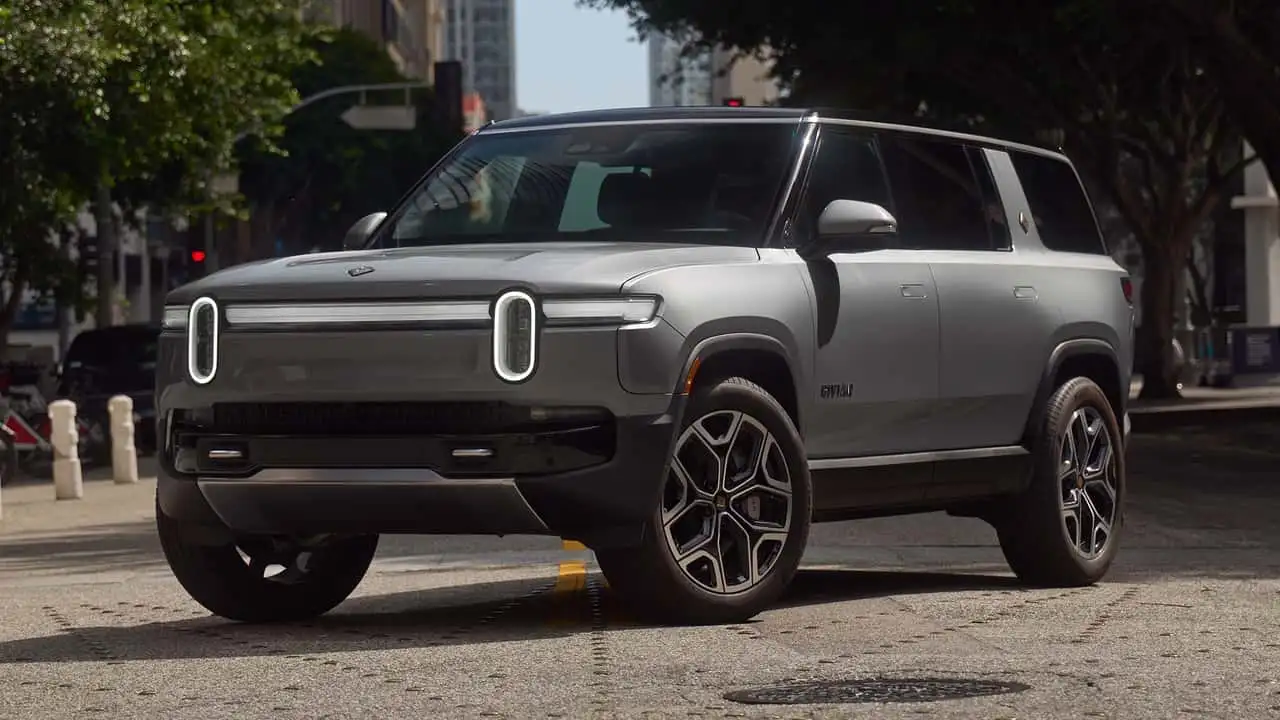
Rivian isn’t completely reinventing its flagship electric SUV and pickup for 2027.
Instead, the company is doing something arguably more important for everyday buyers: making the R1 lineup easier to understand and giving customers some of the features they’ve been asking for.
For the 2027 model year, the Rivian R1S and R1T receive a revised trim structure, new interior options, a new exterior colour and several configuration changes.
But the biggest update is reserved for the R1S.
For the first time, Rivian is offering second-row captain’s chairs, creating a six-seat configuration for its three-row electric SUV.
And according to Rivian, it is the most-requested interior feature from R1S customers.
The changes may look relatively small on paper, but they address some of the biggest practical complaints surrounding the R1 lineup.
The biggest R1S change is inside
The R1S has always offered three rows of seating, but until now buyers had to use a second-row bench.
That meant passengers heading to the third row generally had to move through or around the second-row seats.
For families with children, that could be inconvenient.
Rivian’s new captain’s chairs solve much of that problem.
The 2027 R1S can now be configured with two individual second-row seats separated by a centre passage.
That creates a six-seat layout rather than the traditional seven-seat configuration.
And Rivian has designed the seats specifically around everyday practicality.
Each chair gets:
- Heating
- An individual armrest
- A fold-flat function
- A built-in pop-out cupholder
- Child-seat attachment points
- Easier access to the third row
The centre gap also provides a convenient path to the third row without requiring passengers to fold or slide the second-row seats forward.
For families, that could be a bigger improvement than it initially sounds.
Why captain’s chairs matter in a three-row SUV
Three-row SUVs are increasingly being designed around families.
That means manufacturers have to think about more than passenger capacity.
They need to consider:
How easy is it to install child seats?
Can children reach the third row?
Can an adult move between rows?
Can luggage be carried without sacrificing passenger comfort?
A traditional bench is good for maximum passenger capacity.
Captain’s chairs are generally better for individual comfort and movement through the cabin.
Rivian is essentially giving buyers the choice between those priorities.
The seats were designed with families in mind
There are some clever details.
The captain’s chairs have armrests that can fold away and sit flush against the seat when they’re not being used.
Each chair also gets a cupholder that folds out from the inside edge of the seat.
Perhaps more importantly, the seats can fold flat.
That means Rivian hasn’t sacrificed the ability to carry longer objects simply because the R1S now has individual second-row seats.
The space between the seats can also be useful for transporting long items such as skis, snowboards or other equipment.
It’s a small example of how a family-oriented interior can also remain useful for outdoor activities.
The R1 lineup is getting easier to understand
The second major change is the way Rivian names its R1 variants.
Previously, buyers had to think in terms of Dual Motor, Tri Motor and Quad Motor configurations.
For 2027, Rivian is moving toward a more conventional trim hierarchy:
- Premium
- Performance
- Quad
The Quad name remains because it represents the range-topping four-motor version.
The new naming structure brings the R1 lineup closer to the recently launched R2.
That may sound like a cosmetic change.
But it matters.
Why Rivian is changing the naming system
For enthusiasts, “Dual Motor” and “Tri Motor” immediately communicate something useful.
For an ordinary buyer, however, the terminology can make the lineup unnecessarily complicated.
Is Tri Motor automatically better than Dual Motor?
How much range do you sacrifice?
What equipment comes with each?
Which one is the luxury version?
Rivian’s new structure makes the hierarchy easier to understand.
Premium is the mainstream version.
Performance is the high-performance option.
Quad sits at the top.
That is much easier to communicate to a customer.
The performance numbers haven’t changed
Despite the new names, Rivian hasn’t substantially changed the R1’s underlying performance for 2027.
Premium models continue with the familiar dual-motor setup producing around 533 horsepower, with an optional upgrade to approximately 655 horsepower.
Performance versions continue using the tri-motor system producing approximately 850 horsepower.
The range figures also remain broadly familiar.
For Premium versions, Rivian continues to offer different battery configurations, with maximum range reaching approximately:
- 410 miles for the R1S
- 420 miles for the R1T
The Performance R1S remains around 371 miles of range.
So don’t buy a 2027 R1 expecting a completely different powertrain.
This is primarily a product-positioning and usability update.
The R1 Quad remains the flagship
Rivian isn’t dropping its most extreme model.
The R1 Quad continues at the top of the lineup.
That’s important for Rivian’s brand identity.
The company built much of its reputation around the idea that an EV can combine:
Luxury + performance + off-road capability.
The Quad embodies that philosophy.
With four electric motors, it remains the performance flagship of the R1 family.
The R1 lineup therefore continues to offer a fairly broad range of performance levels, from the more practical Premium models through to the extremely powerful Quad.
The R1T gets a new wheel and tyre combination
The pickup doesn’t get captain’s chairs because, obviously, there is no third row.
Instead, Rivian has focused one of its most notable R1T updates on capability.
The 2027 R1T gets a new 20-inch Adventure All-Season wheel and tyre package designed to provide a better balance between on-road comfort and off-road performance.
That’s an interesting choice.
Rivian buyers often want their vehicles to do more than simply commute.
The R1T is marketed as an adventure-oriented electric pickup, so the ability to leave paved roads is part of its identity.
The new wheel and tyre combination is intended to improve that capability without significantly compromising efficiency.
The R1T can still go a very long way
One of the biggest challenges with electric pickups is balancing off-road capability with range.
Large tyres can increase rolling resistance.
Aggressive tread patterns can reduce efficiency.
Heavy wheels can increase energy consumption.
Rivian’s new tyre strategy appears to be aimed at finding a middle ground.
Car and Driver reports that the R1T Long Range with the new 20-inch setup can achieve up to 380 miles of range, depending on configuration.
That’s impressive for a large electric pickup.
There’s a new silver colour
Both R1 models also get a new exterior colour called Esker Silver.
It replaces the previous LA Silver colour and was first introduced with the R2.
It might sound like a minor change, but colour choices are increasingly important to EV manufacturers.
Rivian has built a distinctive visual identity around colours and materials that are somewhat different from traditional automotive offerings.
Bringing Esker Silver from the R2 into the R1 range helps create a more unified family appearance.
The interior naming is changing too
Rivian has also reorganised its interior options.
The company is moving away from some of the longer descriptions used previously and adopting names that align more closely with the R2.
Depending on trim, buyers can choose from options including:
Black Mountain
Ocean Coast
Black Mountain Signature
Slate Sky Signature
The Signature interiors use more premium materials and distinctive finishes.
For example, Slate Sky Signature combines grey tones with plaid details and walnut wood accents.
Black Mountain Signature uses darker materials with ash wood elements.
Ocean Coast provides a lighter, more subdued appearance.
Rivian is borrowing some R2 thinking
That connection to the R2 is important.
Rivian is entering a new phase as a company.
The R1S and R1T established the brand.
The R2 is intended to take Rivian into a much larger market.
So bringing the naming and design language closer together makes sense.
The customer should increasingly be able to look at a Rivian lineup and understand that the vehicles belong to the same family.
The R1 is the large, premium range.
The R2 is smaller and more accessible.
Future models can fit somewhere within that hierarchy.
The R2 is changing Rivian’s strategy
The R1 vehicles remain extremely important to Rivian, but the company’s long-term growth depends heavily on the R2.
The R2 is smaller and designed to reach a much broader group of buyers.
That means Rivian now has to balance two objectives.
It needs the R1S and R1T to maintain the brand’s premium image and generate revenue.
At the same time, it needs the R2 to expand the customer base.
The 2027 R1 changes help create a clearer distinction between those two product families.
Rivian isn’t abandoning the R1
It’s easy to look at the arrival of the R2 and assume that the R1 vehicles are becoming less important.
The 2027 updates suggest otherwise.
Rivian is still investing in the R1 lineup.
The company is listening to customers.
It’s improving the interior.
It’s refining the trim structure.
It’s adding new equipment.
And it continues to position the R1S and R1T as its premium flagship products.
The R1S may benefit the most
Of the two vehicles, the R1S arguably receives the more meaningful update.
The R1T gets a new wheel and tyre package.
The R1S gets an entirely new seating configuration.
And for a three-row SUV, seating configuration affects the way the vehicle is used every day.
The captain’s chairs could make the R1S considerably more attractive to families.
Seven seats or six?
The answer depends on what you need.
The traditional second-row bench gives the R1S greater passenger capacity.
You can carry seven people.
The captain’s-chair configuration reduces that to six.
But each passenger gets a more comfortable individual seat, and the centre passage makes third-row access easier.
For a family of four or five, six seats may actually be more useful than seven.
For larger families, the bench still makes more sense.
The good news is that Rivian isn’t forcing everyone to choose the same configuration.
But the captain’s chairs aren’t cheap
There is a catch.
The captain’s chairs aren’t simply a free replacement for the bench.
They require the Sound + Vision package, which itself costs extra depending on configuration.
The chairs add another $1,500, while the total cost can reach approximately $4,500 with certain premium interior combinations.
That makes the feature relatively expensive.
For someone buying an R1S at this price level, however, it may still be worthwhile.
Rivian hasn’t changed the R1’s core formula
This is perhaps the most important thing to understand.
The 2027 R1 isn’t a new generation.
The major engineering overhaul already happened for the 2025 model year.
That refresh brought significant changes to the R1’s powertrains, electrical architecture and battery technology.
The 2027 model year is therefore more of an evolution.
Rivian is taking an already capable product and improving the areas customers interact with every day.
That’s a sensible strategy.
Rivian’s electric SUVs are becoming more mature
The R1S has always been an impressive electric SUV.
It combines:
- Three-row seating
- Long range
- High performance
- Off-road capability
- Large cargo capacity
- Advanced software
- A premium interior
But early products often have quirks.
Over time, manufacturers learn what customers actually want.
The captain’s chairs are a good example.
Rivian’s customers told the company what was missing.
Now the company has responded.
This is exactly what software-defined vehicles make possible
Rivian has also built its vehicles around a software-heavy architecture.
That means improvements don’t always require a completely new generation.
Some changes can be introduced through software updates.
Others can be incorporated into model-year production changes.
The R1’s continued evolution demonstrates how EV manufacturers can keep vehicles competitive without completely redesigning them every few years.
The competition is getting tougher
Rivian also has more competition than it did when the R1S and R1T first arrived.
The electric pickup market now includes vehicles such as the:
- Ford F-150 Lightning
- Chevrolet Silverado EV
- GMC Sierra EV
- Tesla Cybertruck
And the electric SUV market is becoming even more crowded.
The R1S now competes with increasingly capable electric SUVs from established automakers as well as newer EV manufacturers.
That makes product refinement increasingly important.
Rivian’s biggest challenge is still price
The R1 vehicles aren’t inexpensive.
For 2027, Rivian lists starting prices of $79,990 for the R1T and $83,990 for the R1S, before applicable fees.
That’s a substantial amount of money.
It puts the R1 vehicles firmly into premium territory.
The R2, by comparison, is intended to bring Rivian’s technology to a much broader customer base.
That makes the R1 a very different proposition.
The R1 has to justify being expensive
At this price level, buyers expect more than good range.
They expect:
- Excellent materials
- Strong performance
- Advanced technology
- Comfortable seating
- Reliable software
- High-quality service
- Distinctive design
The 2027 updates address several of these expectations.
The captain’s chairs improve comfort.
The revised interiors improve choice.
The simplified trims reduce confusion.
The R1T’s new tyres improve versatility.
None of these changes completely transform the vehicle.
Together, however, they make the R1 lineup easier to recommend.
What about the Quad?
For performance enthusiasts, the Quad remains the headline act.
Four electric motors give Rivian a level of control that is difficult to reproduce with a conventional drivetrain.
Each motor can be controlled independently, allowing the vehicle to distribute torque across the wheels.
That can be useful both for acceleration and off-road driving.
It is one of the clearest demonstrations of what electric propulsion can do differently from a petrol engine.
Electric off-roading is becoming more convincing
The R1T and R1S are particularly interesting because they challenge an old assumption.
Electric vehicles aren’t automatically limited to urban driving.
With enough battery capacity and appropriate thermal management, an EV can be extremely capable away from paved roads.
Instant torque is useful when climbing steep surfaces.
Precise motor control can help manage traction.
And the absence of a conventional transmission can simplify certain aspects of power delivery.
The R1 lineup has made that combination one of Rivian’s defining characteristics.
The range question still matters
However, off-roading uses energy differently from highway cruising.
Low speeds, rough terrain, elevation changes and heavy loads can significantly increase consumption.
That means an R1T or R1S owner heading into remote areas still needs to plan carefully.
This is one area where petrol vehicles retain an advantage.
Fuel can be carried and added quickly.
Charging infrastructure remains much more limited in remote areas.
For adventure-oriented EVs, therefore, range isn’t just about the number on the EPA sticker.
It’s about where you can actually recharge.
This matters for African markets too
The R1’s capabilities are particularly interesting when viewed from an African perspective.
Many African markets have large SUVs and pickups that are used for long-distance travel, rough roads and outdoor activities.
An electric vehicle with genuine off-road capability could eventually have a role here.
But infrastructure remains the major obstacle.
A Rivian R1T can theoretically travel hundreds of miles on a charge.
The problem is what happens when you’re hundreds of miles from the nearest reliable DC fast charger.
Until charging networks expand significantly, vehicles like the R1T will remain much easier to use in markets with mature EV infrastructure.
Rivian’s real opportunity is the R2
The R1 vehicles establish what Rivian can do.
The R2 needs to establish how many people Rivian can reach.
That’s why the company’s product strategy is so interesting.
The R1S and R1T are effectively the technology showcase.
The R2 is the volume opportunity.
If Rivian can use the lessons learned from the R1 to create a smaller, more affordable EV, it could significantly expand its market.
The 2027 R1 makes the brand more coherent
The new naming structure is part of that process.
Premium.
Performance.
Quad.
Those names can eventually work across a broader Rivian product family.
A customer doesn’t necessarily need to understand exactly how many motors a vehicle has.
They can simply choose the level of performance they want.
That’s easier to sell.
Is the 2027 R1 a major upgrade?
Not mechanically.
And that’s worth emphasising.
The 2027 R1S and R1T don’t suddenly have dramatically more range or horsepower.
The fundamental powertrains remain largely unchanged.
Instead, Rivian has focused on making a good product more usable.
For the R1S, that’s the captain’s chairs.
For the R1T, it’s the new wheel and tyre option.
For both, it’s the simpler trim structure and refreshed interior choices.
GoGreenway’s verdict
The 2027 Rivian R1 update is a good example of an automaker listening to its customers rather than changing a vehicle simply for the sake of change.
The R1S captain’s chairs are the star of the update.
They make the three-row electric SUV more practical for families while creating an easier path to the third row.
The revised trim structure is also welcome.
Moving from motor-based names like Dual and Tri to Premium, Performance and Quad should make the lineup easier for ordinary buyers to understand.
And the R1T’s new all-season wheel and tyre package adds another layer of practicality for people who actually intend to take the electric pickup off-road.
But the 2027 R1 isn’t a revolution.
It’s a refinement.
And that’s probably exactly what Rivian needs right now.
The company has already demonstrated that it can build highly capable electric vehicles.
Its next challenge is making those vehicles easier to buy, easier to understand and eventually more affordable.
The R1 remains Rivian’s premium statement.
The R2 will determine whether that statement can become a much bigger business.
For now, though, the 2027 R1S and R1T look like smarter, more polished versions of two already compelling electric vehicles.
Sources
- Ars Technica: independent coverage of the 2027 changes, including the captain’s chairs, trim restructuring and unchanged core specifications.
- InsideEVs: detailed reporting on the new R1S seating configuration, pricing and trim changes.
- Car and Driver: independent coverage of the R1S/R1T updates, including the new R1T wheel/tyre package.
- The Verge: reporting on the captain’s chairs, pricing and Rivian’s broader R1/R2 strategy.
- Motor1: additional specifications and details on the revised trim and interior structure.