Review methodology: This review is based on Hyundai’s published specifications and independent road tests from established automotive publications. GoGreenway did not independently road-test this vehicle.
The electric SUV market is becoming increasingly crowded, but relatively few electric vehicles combine three-row practicality, long range and genuinely fast charging.
The 2026 Hyundai IONIQ 9 is designed to do exactly that.
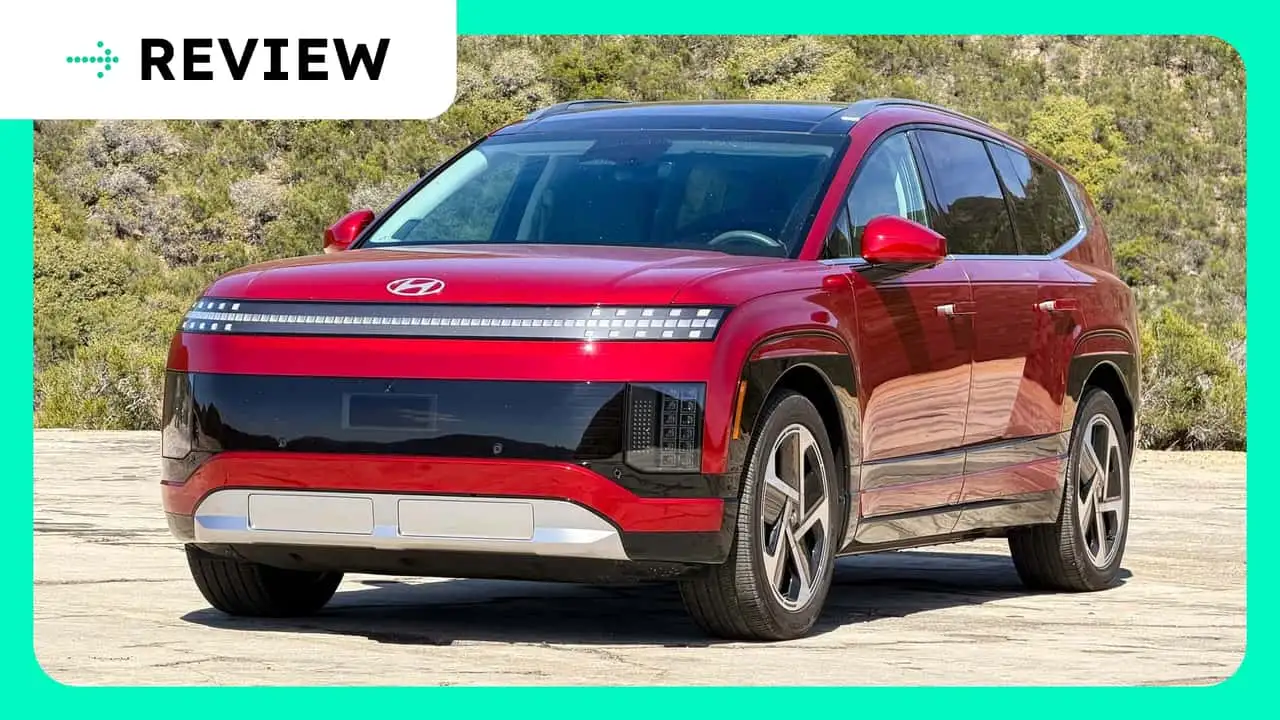
Hyundai’s largest IONIQ model is a three-row electric SUV built on the company’s E-GMP electric platform. It offers seating for up to seven people, a 110.3-kWh battery and a choice of rear-wheel-drive and all-wheel-drive powertrains. Depending on the version and testing standard, the IONIQ 9 can deliver more than 300 miles of rated range.
It is also closely related to the Kia EV9, but Hyundai has given the IONIQ 9 its own personality, with a more futuristic exterior, a lounge-like cabin and a strong emphasis on quietness and long-distance comfort.
Based on Hyundai’s specifications and independent road testing, the IONIQ 9 makes a compelling argument for the idea that a large family SUV does not have to sacrifice practicality simply because it has an electric powertrain.
A large EV designed around family life
The first thing to understand about the IONIQ 9 is that it is not a small or lightweight electric crossover.
It measures 5,060 mm long, 1,980 mm wide and 1,790 mm high, with a 3,130-mm wheelbase.
That long wheelbase is important because it gives Hyundai considerable room to work with inside the cabin.
The IONIQ 9 can be configured with six or seven seats depending on the market and specification.
Hyundai has also designed the interior around the idea of making a large SUV feel more like a lounge.
Available features include relaxation seats, second-row swivel seats in selected markets, a sliding centre console and a flat floor made possible by the electric platform.
For families, those details could matter more than outright acceleration.
The third row is one of its biggest advantages
Three-row SUVs often have a problem: the third row technically exists, but adults don’t really want to sit there.
The IONIQ 9 does better than many traditional SUVs.
Independent testing by Car and Driver found 32 inches of third-row legroom, while the second row has 42.8 inches.
That does not turn the IONIQ 9 into a minivan.
But it does make the third row considerably more useful for families carrying children or adults on shorter journeys.
The E-GMP platform helps here because the absence of a conventional engine and transmission creates more freedom to package the interior.
There is a lot of space for luggage
Passenger space is only half the equation for a family SUV.
There’s also luggage.
Car and Driver measured approximately 22 cubic feet of cargo space behind the third row, increasing to around 46 cubic feet with the third row folded.
The exact measurement varies depending on the market and measurement standard, but the basic point remains:
The IONIQ 9 is designed to carry people and their luggage without forcing owners to choose between the two.
Hyundai also provides a front trunk, although the capacity varies between rear-wheel-drive and all-wheel-drive versions.
For a large family EV, that is a meaningful advantage.
The battery is enormous
The IONIQ 9 uses a 110.3-kWh lithium-ion battery across its main powertrain configurations.
That is a substantial battery.
It also explains why Hyundai can offer a large SUV with a driving range exceeding 300 miles under EPA testing in the United States.
The Long-Range RWD version has an EPA-estimated range of up to 335 miles, while Long-Range AWD models are rated at around 320 miles and Performance AWD versions at around 311 miles.
Hyundai’s European specification gives the Long-Range RWD version a projected 620-km WLTP range.
These figures should not be compared directly because EPA and WLTP testing use different methodologies.
The important takeaway is that the IONIQ 9 offers genuinely long-range capability for a three-row electric SUV.
There are three powertrain options
Hyundai offers three basic powertrain configurations.
Long-Range RWD
The entry configuration uses a single rear-mounted motor producing around 160 kW (218 PS) and 350 Nm of torque.
It is the efficiency-focused option and offers the highest rated range.
Long-Range AWD
The all-wheel-drive version adds a front electric motor, bringing combined output to approximately 226 kW (307 PS) and 605 Nm.
This is likely the sweet spot for buyers who want more performance and all-weather traction without necessarily needing the most powerful version.
Performance AWD
At the top of the range is the Performance AWD model.
It produces approximately 314 kW (427 PS) and 700 Nm of torque according to Hyundai’s technical specifications.
Hyundai quotes 0–100 km/h in around 5.2 seconds for the Performance version.
Independent testing has been even more impressive. Car and Driver recorded 4.4 seconds from 0 to 60 mph in a Performance AWD model.
That is remarkable performance for a large three-row family SUV.
But performance isn’t really the point
The IONIQ 9 can accelerate quickly, but its character is not built around sporty driving.
This is a large family vehicle.
Its strengths are comfort, quietness, space and effortless acceleration.
Car and Driver described the ride and handling as favouring comfort while retaining reasonable composure, and recorded an interior noise level of around 66 decibels at 70 mph.
That makes sense.
The IONIQ 9 is designed to make long journeys less tiring rather than turn every corner into an event.
For its intended audience, that is probably the right priority.
Charging is one of the IONIQ 9’s strongest features
This is where Hyundai’s E-GMP architecture becomes particularly important.
The IONIQ 9 uses an 800-volt electrical architecture and can accept DC fast charging at up to 350 kW.
Hyundai says the vehicle can charge from 10% to 80% in approximately 24 minutes when connected to an appropriate 350-kW charger.
That is a significant advantage for long-distance travel.
Hyundai also says the vehicle can add approximately 304 km of range in 15 minutes under suitable charging conditions.
Of course, those figures depend on the charger, battery temperature, state of charge and other conditions.
A 350-kW charger is also considerably more powerful than the charging infrastructure available in many markets.
That distinction matters enormously for buyers in Africa.
The Nigerian problem: the car may be ready before the infrastructure
This is where the IONIQ 9 becomes particularly interesting from a Nigerian perspective.
The vehicle itself is capable of very fast charging.
But Nigeria’s public EV-charging network is nowhere near as developed as the networks found in major European, North American or East Asian markets.
That means the IONIQ 9’s impressive charging capability may not always be usable to its full potential.
For a Nigerian owner, home charging could therefore be particularly important.
If the vehicle is parked at home overnight and connected to an appropriately installed charger, most daily charging needs can potentially be handled without relying heavily on public infrastructure.
But long-distance travel requires much more planning.
The availability, reliability and power rating of public charging stations should therefore be considered before buying a large imported EV such as the IONIQ 9.
Range is impressive — but don’t expect 335 miles every day
This is an important distinction.
The EPA-rated 335 miles for the RWD model is a laboratory test result.
Real-world range depends on:
- Speed
- Temperature
- Road conditions
- Driving style
- Wheel and tyre configuration
- Climate-control use
- Vehicle load
- Battery condition
Car and Driver’s Performance AWD test illustrates the difference.
The vehicle is rated for 311 miles by the EPA, but the publication achieved 260 miles during its 75-mph highway range test.
That does not mean the EPA figure is misleading.
It simply demonstrates why buyers should treat official range figures as a benchmark rather than a guarantee.
The cabin is one of the IONIQ 9’s biggest strengths
Hyundai has taken a different approach to the interior.
Instead of filling every surface with screens and complicated controls, the IONIQ 9 aims for a more relaxed environment.
The dashboard uses a pair of 12.3-inch displays integrated into a curved panel, while the cabin incorporates sustainable materials and multiple USB-C charging points.
There are also available relaxation seats with massage functions.
Depending on specification, buyers can get features such as a Bose audio system, head-up display and additional premium materials.
The result is an interior that feels more like a high-end family lounge than a traditional SUV cabin.
But the interior isn’t perfect
Despite the premium positioning, independent reviewers have identified some areas where Hyundai could have done better.
Car and Driver praised the quietness and overall environment but criticised some interior material choices, particularly certain plastic components that did not match the quality suggested by the rest of the cabin.
That’s an important observation.
A vehicle that can cost well into premium-SUV territory faces higher expectations from buyers.
The IONIQ 9 does many things very well, but it doesn’t completely escape the compromises associated with a mass-market manufacturer trying to compete in an increasingly premium EV segment.
Technology is everywhere
The IONIQ 9 comes with a substantial technology package.
Features include:
- EV route planning
- Connected vehicle services
- Wireless smartphone charging
- Digital key functionality
- Multiple USB-C ports
- Driver-assistance systems
- Available head-up display
- Vehicle-to-load functionality in selected markets
Hyundai has also incorporated battery preconditioning, which can prepare the battery for faster DC charging when conditions allow.
These technologies matter because EV ownership isn’t only about the motor and battery.
Software and charging management increasingly influence how easy an EV is to live with.
How does it compare with the Kia EV9?
The IONIQ 9’s closest relative is arguably the Kia EV9.
Both use Hyundai Motor Group’s E-GMP architecture.
Both offer three rows.
Both are large electric family SUVs.
And both prioritise comfort and practicality.
But Hyundai has given the IONIQ 9 a more aerodynamic and futuristic design while focusing heavily on refinement.
The two vehicles are therefore less like completely different products and more like two interpretations of the same underlying electric architecture.
That is actually a good thing for consumers.
It gives buyers more choice without requiring manufacturers to develop completely separate EV platforms.
What about towing?
The IONIQ 9 is not merely a family shuttle.
The US-specification vehicle can tow up to 3,500 pounds in the rear-wheel-drive version and up to 5,000 pounds in all-wheel-drive versions, according to Car and Driver.
That makes the AWD versions considerably more useful for owners who need to tow.
However, towing an EV trailer or caravan can have a substantial effect on range.
So buyers should not assume that a 300-plus-mile rated vehicle will maintain anything close to that range while towing.
Is the IONIQ 9 suitable for Africa?
Potentially, yes — but with important qualifications.
The vehicle’s large battery and three-row cabin could make it attractive to wealthy families, corporate users and premium mobility operators.
Its relatively long range is also useful in markets where charging infrastructure is sparse.
However, the IONIQ 9 is a large and expensive vehicle.
It is not necessarily the most practical EV for the average African driver.
Its size can also be inconvenient in cities where roads and parking infrastructure were not designed around large SUVs.
And perhaps most importantly, access to high-power charging remains a major constraint.
The vehicle’s technical capabilities are ahead of the charging ecosystem in many African markets.
The IONIQ 9’s biggest strengths
After looking at the specifications and independent testing, several advantages stand out.
1. Excellent interior space
The three-row configuration makes the IONIQ 9 a genuine family vehicle rather than an SUV with an occasional-use third row.
2. Strong range
The RWD version can reach an EPA-rated 335 miles, while the European WLTP figure is up to 620 km.
3. Very fast charging
The 800-volt system and 24-minute 10–80% charging claim make the IONIQ 9 particularly well suited to long journeys where suitable chargers are available.
4. Comfortable character
The vehicle is designed primarily around quiet, relaxed travel rather than aggressive handling.
5. Impressive performance
The Performance AWD version is genuinely quick for something this large, with independent testing recording 4.4 seconds to 60 mph.
Its biggest weaknesses
It also has some drawbacks.
1. It is expensive
The IONIQ 9 is positioned significantly above Hyundai’s smaller EVs.
In the US market, the 2026 model starts around $60,000 before options and rises toward $80,000 for high-spec versions.
Import costs would make the vehicle considerably more expensive in markets such as Nigeria.
2. It is large
This is not a compact urban EV.
Parking, manoeuvring and narrow roads can be challenging.
3. Charging infrastructure limits its potential
Its 350-kW charging capability is excellent, but only when suitable infrastructure is available.
4. Some interior materials disappoint
The cabin is generally impressive, but independent reviewers found some material choices less premium than expected.
5. Real-world range can be lower than the headline figure
As with every EV, highway driving and other demanding conditions can significantly reduce range.
Is the 2026 Hyundai IONIQ 9 worth buying?
For the right buyer, yes.
The IONIQ 9 is one of the more convincing large electric SUVs currently available because it does not treat electrification as the only selling point.
It is first and foremost a practical family vehicle.
It has three rows.
It has a large cargo area.
It is quiet.
It has long-range capability.
And when connected to a sufficiently powerful charger, it can recover a large amount of range quickly.
The compromises are mainly related to price, size and infrastructure rather than fundamental weaknesses in the electric powertrain.
GoGreenway’s take
The IONIQ 9 is an important vehicle because it demonstrates how far electric SUVs have progressed.
Early EVs often required buyers to accept compromises in range, charging speed, practicality or performance.
The IONIQ 9 reduces many of those compromises.
Its 110.3-kWh battery provides more than 300 miles of EPA-rated range in every US configuration, while the 800-volt architecture enables very fast DC charging.
More importantly, it offers something that many EVs still struggle to provide: genuine three-row family practicality.
That does not make it perfect.
It is large, expensive and dependent on charging infrastructure that is still developing in many parts of the world.
For Nigeria and much of Africa, those limitations are especially important.
But as a demonstration of what a modern family EV can do, the IONIQ 9 is impressive.
It isn’t simply an electric SUV with three rows. It is a genuinely capable family SUV that happens to be electric — and that may ultimately be the more important achievement.