One of the strangest things about switching from a petrol or diesel car to an electric vehicle is discovering that the EV may still have a Start/Stop button.
It seems almost unnecessary.
There is no petrol engine to crank.
There are no spark plugs to ignite fuel.
There is no starter motor spinning an engine into life.
So what exactly happens when you press the button?
The short answer is that you aren’t starting an engine.
Instead, the button helps put the vehicle’s electrical and control systems into the appropriate operating state and, depending on the model, confirms that the car is ready to drive.
And there is a surprisingly good reason some manufacturers have decided to keep the familiar button.
An EV doesn’t need an engine to “start”
In a conventional petrol or diesel car, starting the vehicle is a mechanical process.
You turn the key or press the Start button.
The starter motor turns the engine.
The engine begins combustion.
Once it is running, the engine provides the mechanical power needed to move the vehicle and operate many of its systems.
An EV works very differently.
Its traction motor doesn’t need to idle before the vehicle can move.
There is no combustion process to initiate.
Instead, the vehicle’s electronic control systems establish the conditions necessary for the high-voltage drivetrain to operate.
That’s why an EV can be completely silent and still be ready to move.
So what does the Start button actually do?
Think of it less as an engine-start button and more as a vehicle-activation button.
When you press it — normally while holding the brake pedal — the vehicle checks the necessary conditions and can enter its ready-to-drive state.
Hyundai’s EV documentation, for example, instructs drivers to put the vehicle in Park, press the brake pedal and press the Start/Stop button. Once the vehicle enters READY mode, the READY indicator illuminates.
At that point, the car is ready to move.
There is still no engine running.
What is the “READY” light?
This is one of the most important things for a new EV driver to understand.
A conventional car usually gives you an obvious indication that the engine is running: you can hear and feel it.
An EV doesn’t necessarily provide those clues.
Instead, manufacturers use indicators such as READY to tell the driver that the vehicle is in its drive-ready state.
Hyundai describes the READY indicator as meaning that normal driving is possible. If the indicator is off, normal driving isn’t possible or there may be a problem.
So if you get into an EV, press the button and see READY appear on the instrument cluster, that’s effectively the vehicle saying:
“I’m awake, the systems are active and I’m ready to drive.”
Why not just make the car turn on automatically?
Some manufacturers have done exactly that.
Not every EV has a traditional Start/Stop button.
Some vehicles can detect the driver’s key or phone, wake up automatically and allow the driver to select a gear and drive.
That demonstrates something important:
The physical button isn’t technically necessary for an electric vehicle.
It is a design choice.
Different manufacturers have simply chosen different ways of handling the transition between parked, active and ready-to-drive states.
Hyundai has a reason for keeping it
This isn’t just an accident left over from petrol cars.
Hyundai has explained that it continues to use a Start/Stop button on some of its EVs because it gives drivers a clear indication that the vehicle has entered its READY state.
The company also says the familiar interaction can make the transition from an internal-combustion vehicle to an EV easier for drivers who are new to electric cars.
And that makes a lot of sense.
Imagine someone who has driven petrol cars for 20 years getting into an EV for the first time.
They press the button.
Nothing happens.
No engine noise.
No vibration.
No exhaust note.
They might genuinely wonder whether the car is even on.
A Start button gives them a familiar point of interaction.
An EV can be “on” without moving
Another reason the terminology can be confusing is that an electric vehicle can have several different electrical states.
For example, Hyundai documents states such as:
OFF — the vehicle is switched off.
ACC — some electrical accessories can operate.
ON — the vehicle’s electrical systems are active.
READY — the vehicle is prepared for normal driving.
The exact names and behaviour vary between manufacturers.
But the underlying idea is similar.
An EV isn’t simply:
OFF → ENGINE RUNNING
Instead, it can move through different electrical and control states.
Why does the car need all those checks?
Because an electric vehicle still contains a huge amount of technology.
Before allowing the drivetrain to operate, the vehicle may need to confirm things such as:
- The correct key or digital key is present
- The vehicle is in Park
- The brake pedal is being pressed
- The high-voltage system is available
- The charging cable isn’t connected in a way that prevents driving
- Relevant electronic systems are functioning correctly
- There are no critical faults preventing operation
The Start/Stop process is therefore also part of the vehicle’s authorization and safety system.
It’s not merely an imitation of a petrol-car ignition.
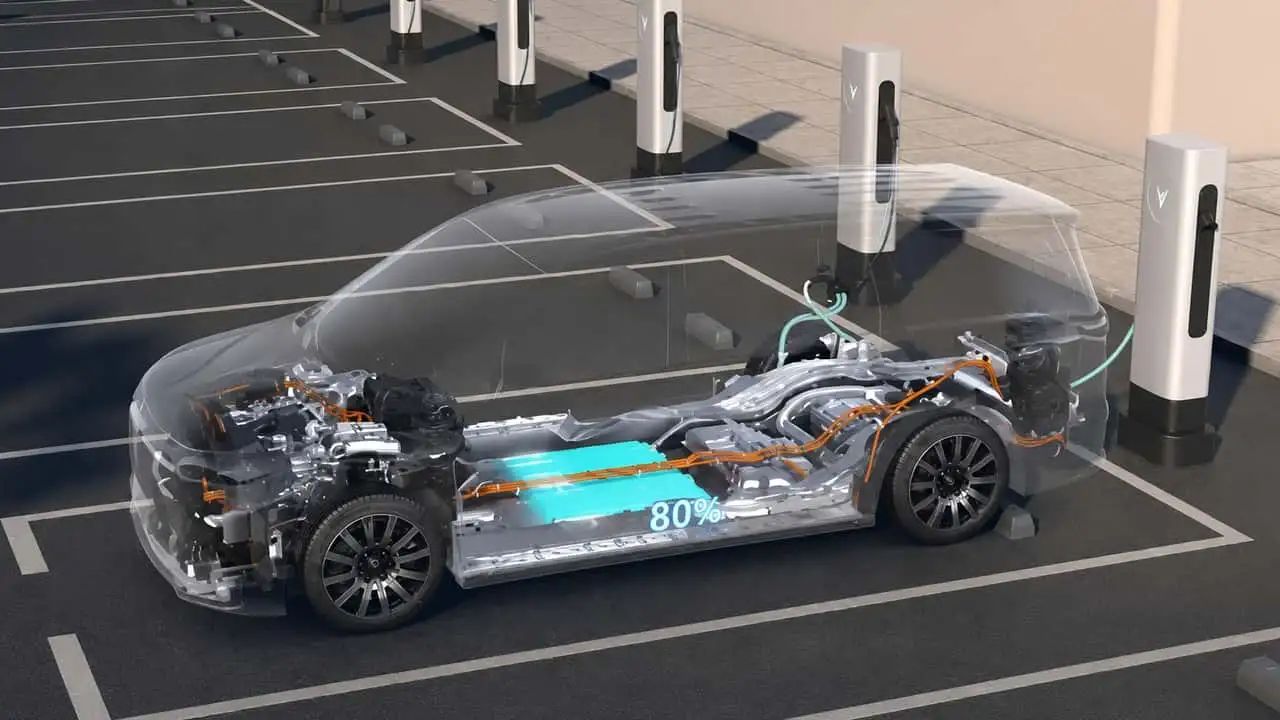
The high-voltage battery doesn’t simply power the motor directly
Modern EVs contain sophisticated electrical systems between the battery and the wheels.
The battery stores DC electrical energy.
Power electronics control how that energy is delivered.
The inverter converts electrical power into the form required by the traction motor.
Other control modules constantly monitor the vehicle.
So when an EV becomes READY, a lot more is happening than simply switching on a screen.
What happens when you press the accelerator?
Once the EV is in its ready state, the drivetrain can respond to accelerator input.
The electric motor doesn’t need to build up engine speed before producing useful torque.
Power can be delivered very quickly.
That’s why an EV can feel almost instantaneous when pulling away.
And because the motor doesn’t need to idle, the vehicle can remain stationary without keeping the traction motor continuously running.
This is completely different from idling
A petrol engine normally has to continue running while a conventional vehicle is stopped, unless its automatic start-stop system temporarily shuts the engine down.
An EV doesn’t have this problem.
If you stop at a traffic light, the traction motor doesn’t need to sit there spinning.
It can simply remain inactive until the vehicle needs to move again.
That’s one of the reasons EVs can be so quiet in traffic.
So why do some EVs still make noise?
Because silence can create another problem.
Pedestrians may not hear the vehicle approaching.
At low speeds, especially in car parks and residential areas, an EV can be difficult to detect by sound.
That is why many EVs use an artificial warning sound.
Hyundai calls its system Virtual Engine Sound System (VESS).
Hyundai’s documentation explains that VESS generates sound to alert pedestrians when the EV is operating, including when the vehicle is in READY mode and not in Park.
The sound isn’t there because the electric motor needs it.
People need it.
The irony of an “engine sound” in an electric car
This is one of the stranger transitions in the automotive industry.
An electric car has no combustion engine.
Yet it can have:
- An “engine” sound
- An “engine” start button
- An “engine” start procedure
None of these necessarily means there is an engine.
They are largely familiar interfaces or safety features carried into a new type of vehicle.
What happens when you press Stop?
The reverse process happens.
Depending on the vehicle, pressing the Start/Stop button while the car is in Park takes it out of its ready-to-drive state.
Hyundai’s documentation says that pressing the button with the vehicle in Park turns it off. If the button is pressed while the vehicle is in Drive, Reverse or Neutral, the system can automatically shift to Park on certain models.
Again, there is no engine being “stopped.”
The vehicle is simply being taken out of its normal driving state.
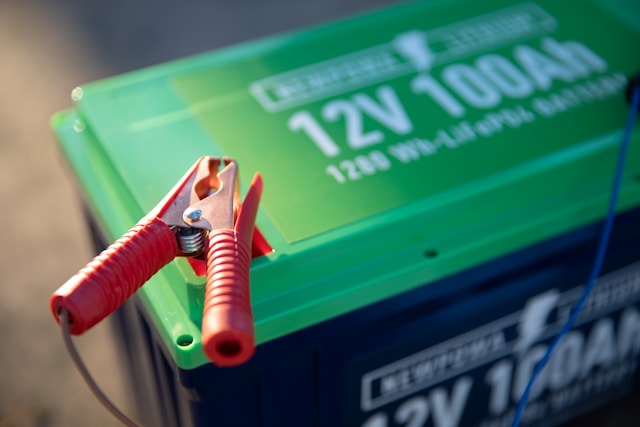
What about the 12-volt battery?
EVs still have low-voltage electrical systems.
That’s an important point for people new to electric cars.
The large high-voltage battery is responsible for powering the traction system, but EVs also use a low-voltage electrical system for many conventional vehicle functions.
Hyundai’s documentation, for example, distinguishes ACC and ON states in which the 12V electrical system supplies power to accessories and other electronics.
So even though an EV doesn’t have an engine, it still has electrical systems that need to be powered and managed.
Does an EV consume electricity when it is “on”?
Yes.
The vehicle’s computers, displays, climate-control system, communications equipment and other components can consume electricity.
But that is very different from keeping a petrol engine running at idle.
The amount of energy consumed varies considerably depending on what the vehicle is doing.
Heating or cooling the cabin, for example, can use substantially more energy than simply keeping the vehicle’s electronics awake.
What happens when you leave the car?
This also varies by manufacturer.
Some EVs can automatically detect that the driver has left and switch to a parked state.
Others use a more conventional procedure.
That’s why it is important not to assume that every EV operates exactly like another EV.
The owner’s manual is still the final authority.
Tesla takes a different approach
Tesla is one of the better-known examples of an EV manufacturer that has moved away from the traditional Start/Stop-button concept on many models.
Instead of requiring the driver to press a conventional start button, Tesla vehicles can use key cards, phones and other authentication methods to determine when the vehicle should be accessible and ready for operation.
Other EV manufacturers have gone in the opposite direction.
This isn’t really a question of which technology is “correct.”
It’s a question of user interface.
Rivian also shows that the button isn’t essential
Some newer EVs have eliminated the conventional start button entirely.
Rivian’s R1 models, for example, use a different approach in which the vehicle can wake up and become ready to drive without the traditional start-button ritual.
This shows where the automotive industry could eventually be heading.
As vehicles become better at identifying their drivers and managing their own operating states, physical Start buttons may become less important.
Why haven’t all manufacturers removed them?
There are several reasons.
Familiarity
Drivers already understand what a Start/Stop button does.
Removing it introduces another thing that a new EV owner has to learn.
Safety
A deliberate activation sequence gives the driver a clear indication that the vehicle is entering its drive-ready state.
Driver expectations
Many people still expect a vehicle to have some kind of “start” procedure.
Brand philosophy
Some manufacturers want the car to feel familiar.
Others want it to feel completely new.
Neither approach is inherently wrong.
There’s also a psychological element
This might be the most interesting reason.
Humans like familiar controls.
If you’ve spent decades turning a key or pressing a button to start your car, suddenly getting into a silent vehicle that simply wakes up when you sit down can feel strange.
The Start/Stop button provides a small piece of familiarity during a much bigger technological transition.
It’s essentially a bridge between two generations of cars.
Is the Start button becoming obsolete?
Possibly.
As digital keys, smartphone authentication, facial recognition, driver monitoring and other technologies improve, vehicles can increasingly determine who is driving and what state the car should be in.
That means the traditional Start button could eventually disappear.
The driver might simply:
Unlock → sit down → select Drive → go.
Some EVs are already moving toward this experience.
But there is still value in a physical control
Even as cars become more automated, physical controls have advantages.
They’re easy to find.
They provide tactile feedback.
They don’t require looking at a touchscreen.
And they give drivers a clear sense that something deliberate has happened.
For a safety-critical function, that can be useful.
What new EV drivers should remember
The most important lesson isn’t whether your car has a Start button.
It’s this:
Never assume an EV is off simply because you can’t hear anything.
A silent EV can be fully ready to move.
Before selecting Drive or Reverse:
- Check the instrument cluster.
- Look for the READY indicator or the vehicle’s equivalent.
- Keep your foot on the brake.
- Check your surroundings.
- Be particularly careful around pedestrians and children.
- Follow the specific procedure in your vehicle’s owner’s manual.
Hyundai itself warns that an EV can move when it is in READY mode and advises drivers to be aware that the vehicle may be essentially silent.
What this means for Nigerian EV drivers
This is particularly relevant as electric vehicles become more visible on Nigerian roads.
A first-time EV driver may sit inside the vehicle, press the button and wonder why nothing appears to happen.
There may be no engine vibration.
There may be no exhaust noise.
There may be no traditional sensation of a mechanical engine coming alive.
But if the vehicle displays its READY indication, it may be completely prepared to move.
That makes learning the vehicle’s specific indicators especially important.
And in busy urban environments such as Lagos, where pedestrians, motorcycles and cars often operate in close proximity, the quietness of an EV is something drivers should take seriously.
The bigger lesson about EV design
The Start/Stop button is actually a good example of how quickly automotive technology is changing.
Electric cars don’t need many of the mechanical processes that defined traditional automobiles.
But manufacturers don’t necessarily need to throw away every familiar control.
Instead, they’re gradually deciding which parts of the traditional driving experience are still useful.
Some will disappear.
Others will remain because they make the vehicle easier or safer to understand.
So, why does an electric car have a Start/Stop button?
Because the button isn’t really starting an engine.
It’s controlling the vehicle’s operating state.
On EVs that use one, pressing the button can activate the vehicle’s electronics, authorize the driving systems and transition the car into its READY state.
The electric motor itself doesn’t need to warm up, idle or be mechanically cranked.
That’s why an EV can be completely silent and still be ready to accelerate.
And as EVs become more sophisticated, the Start/Stop button may eventually disappear altogether.
But for now, it remains a useful bridge between the familiar world of petrol cars and the very different way electric vehicles operate.
Sources
- Hyundai Owner’s Manual — Starting the vehicle: explains the Start/Stop sequence and READY mode.
- Hyundai Owner’s Manual — Start/Stop button positions: explains OFF, ACC, ON and START states.
- Hyundai Owner’s Manual — READY indicator: explains what the READY light means.
- Hyundai Owner’s Manual — VESS: explains why EVs can produce artificial sounds for pedestrians.
- InsideEVs — EV Start/Stop buttons: provides independent context on why some EV manufacturers retain the button while others remove it.