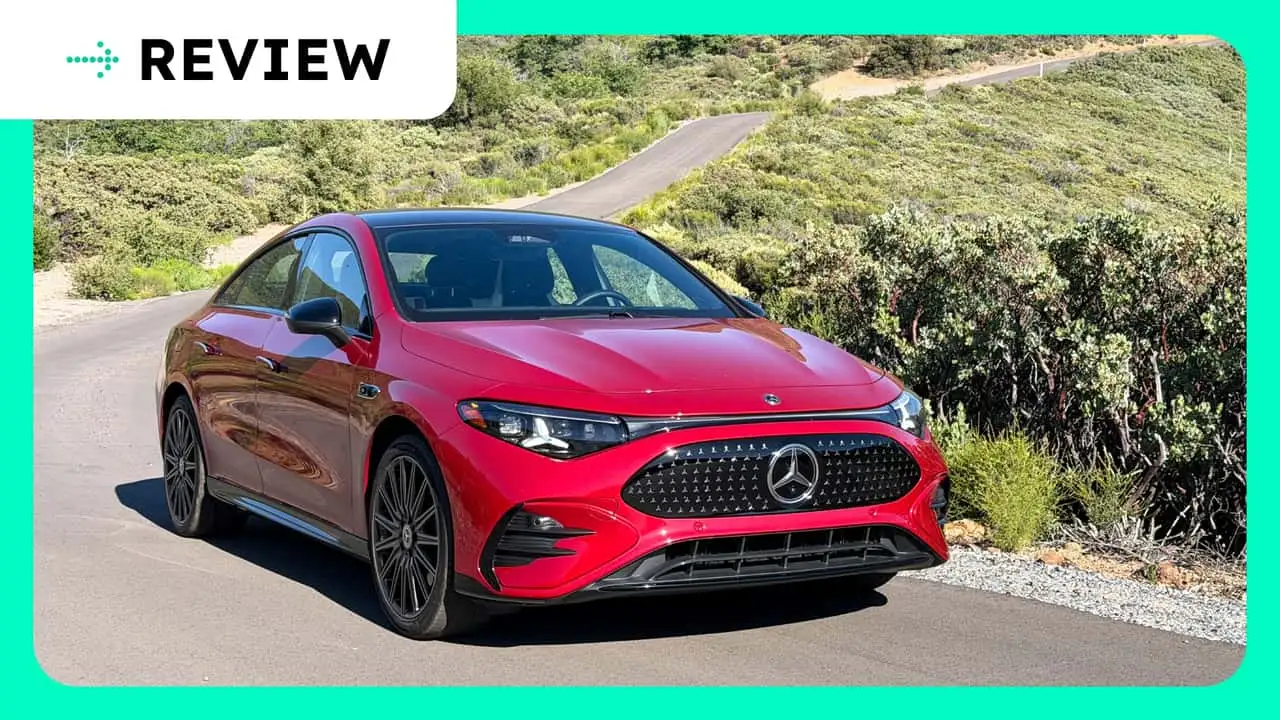
Mercedes-Benz is taking a very different approach with its new electric CLA.
Rather than simply converting an existing petrol-powered sedan into an EV, the company has developed the latest CLA around a new electric-focused architecture, an 800-volt electrical system and a new software platform called MB.OS.
The result is one of the most efficient electric cars Mercedes-Benz has produced.
The CLA 250+ can officially travel up to 374 miles (602 km) on the EPA cycle in the United States, while Mercedes quotes up to 792 km of WLTP range for the most efficient European configuration. Independent testing has made the numbers even more interesting: Edmunds managed 434 miles (698 km) from a CLA 250+ in its real-world range test.
It also charges extremely quickly, drives well and has a high-tech interior.
But the new CLA isn’t perfect.
Some of Mercedes’ technology feels genuinely useful. Other parts seem unnecessarily complicated.
And although the car’s efficiency is excellent, the interior quality, rear-seat space and some charging decisions prevent it from being an unquestionable class leader.
A New Beginning for Mercedes EVs
The electric CLA is important because it represents the beginning of a new generation of Mercedes-Benz electric vehicles.
It is based on Mercedes’ MMA (Mercedes Modular Architecture) platform and introduces an 800-volt electrical system alongside the company’s new MB.OS software platform.
That makes it fundamentally different from simply taking a petrol CLA and replacing the engine with an electric motor.
Mercedes designed the platform around electrification from the start.
And that decision is particularly noticeable when you look at efficiency.
The Range Is the Star of the Show
If there’s one number that immediately gets your attention, it’s the range.
The CLA 250+ has an EPA-rated range of up to 374 miles in the U.S.
That’s already impressive.
But independent testing makes the result even more interesting.
Edmunds drove the CLA 250+ for 434 miles in its real-world EV Range Test, beating the official EPA figure by 16%.
That’s an exceptional result.
It also demonstrates something important about modern EVs:
Efficiency can be just as important as battery size.
Mercedes Isn’t Simply Using a Giant Battery
The CLA 250+ uses an 85-kWh battery, which is substantial but not enormous by modern EV standards.
The impressive range comes from combining that battery with an extremely efficient drivetrain and aerodynamic body design.
The car has been designed to move through the air with as little resistance as possible.
That matters particularly at highway speeds.
The less energy the vehicle needs to maintain speed, the farther it can travel using the same amount of stored electricity.
Edmunds’ Test Shows How Efficient It Really Is
The Edmunds test is particularly useful because it gives us something beyond a laboratory figure.
The CLA 250+ consumed just 23.4 kWh per 100 miles in Edmunds’ testing, making it one of the most efficient EVs the publication has tested.
That is a major achievement.
It means Mercedes isn’t relying entirely on battery capacity to achieve long range.
The vehicle itself is doing much of the work.
It Drives Better Than You Might Expect
The CLA’s efficiency doesn’t come at the expense of driving enjoyment.
The CLA 250+ produces 268 horsepower and sends power to the rear wheels.
It isn’t intended to be a high-performance AMG-style rocket.
Instead, Mercedes has aimed for a balance between efficiency, comfort and responsiveness.
And that works.
The car feels quick when you need it to, but its biggest strength is how composed it feels while driving.
Car and Driver recorded a 5.8-second 0–60 mph time for the CLA 250+, quicker than Mercedes’ own estimate.
There Is Also a More Powerful Version
For buyers who want more performance, Mercedes offers the CLA 350 4MATIC.
It uses two electric motors and produces up to 349 horsepower.
The additional motor gives the car all-wheel drive and significantly stronger acceleration.
Interestingly, the extra performance doesn’t completely destroy the CLA’s efficiency.
Autocar’s testing of the CLA 350 found that it could still deliver around 375 miles of real-world range in mixed driving.
That makes the 350 a more compelling performance upgrade than some dual-motor EVs, which often sacrifice a significant amount of range for additional power.
Mercedes’ Two-Speed Gearbox Is Unusual
Another interesting feature is the electric CLA’s two-speed transmission.
Most EVs use a single-speed gearbox.
Mercedes has chosen a different solution.
The idea is to provide strong acceleration at lower speeds while allowing the drivetrain to operate efficiently at higher speeds.
It is another example of Mercedes trying to extract as much efficiency as possible from the vehicle.
However, there is a trade-off.
Autocar noted that the gear change can be noticeable under hard acceleration.
For most drivers, it probably won’t matter.
But it’s unusual in an EV, where smooth, uninterrupted acceleration has traditionally been part of the appeal.
Charging Is Seriously Fast
The CLA’s 800-volt architecture is another major advantage.
Mercedes says the car can accept up to 320 kW of DC charging power when connected to an appropriately powerful charger.
Under suitable conditions, Mercedes claims a 10–80% charge in around 22 minutes.
That’s excellent.
But independent testing gives us a more useful picture.
Edmunds recorded an average charging rate of approximately 193 kW from 10–80%, while the car demonstrated extremely strong charging performance overall.
The headline 320-kW figure therefore shouldn’t be interpreted as something the car continuously maintains throughout a charging session.
Like virtually every EV, charging power varies depending on battery temperature, state of charge and charger capability.
The 400-Volt Charging Issue Is More Interesting
Here’s one of the CLA’s biggest weaknesses.
The car’s 800-volt system works brilliantly with compatible high-power charging infrastructure.
But not every fast charger uses an 800-volt system.
Some older DC fast chargers operate at 400 volts.
And this is where Mercedes has made an unusual decision.
Autocar reports that compatibility with older 400-volt DC rapid chargers requires an additional converter, which is offered as a paid option and is limited to 100 kW on those systems.
That could be a significant disadvantage depending on where you live.
This Matters in Countries With Older Charging Infrastructure
The CLA’s technical capabilities are impressive.
But an EV is only as convenient as the charging infrastructure available to it.
If you’re driving around a country where most fast chargers are newer and powerful, the CLA’s 800-volt system is a major advantage.
If many of the available chargers are older 400-volt units, the experience can be less impressive.
That distinction is particularly important when considering markets outside Western Europe and North America.
What About Nigeria?
For a Nigerian buyer, the CLA’s long range could actually be one of its biggest strengths.
The less frequently you need to charge, the less dependent you are on public charging infrastructure.
Someone driving a moderate daily distance could potentially go several days between charging sessions.
But home charging would be extremely important.
A buyer who has dedicated parking and can install a suitable charger would have a much easier ownership experience than someone who depends entirely on public charging stations.
Lagos Could Be Interesting for the CLA
The CLA’s relatively compact sedan dimensions could make it more manageable in a busy city such as Lagos than a large electric SUV.
And because EVs recover energy through regenerative braking, stop-and-go traffic isn’t necessarily as inefficient as it is for petrol vehicles.
But there is still one major question:
Where do you charge it?
For Nigerian EV buyers, charging access remains a much more important consideration than the maximum charging speed advertised on the specification sheet.
The Interior Is Extremely High-Tech
Step inside the CLA and Mercedes’ priorities become obvious.
The cabin is dominated by large digital displays.
The new MB.OS software platform is designed to integrate navigation, entertainment, voice assistants and other connected services.
The overall impression is futuristic.
And if you enjoy technology, you’ll probably love it.
But Mercedes has also created a problem for itself.
When a vehicle relies heavily on screens, the software has to be exceptionally intuitive.
The Superscreen Looks Impressive
The large screen arrangement gives the CLA a distinctive appearance.
It’s modern.
It’s visually impressive.
And it makes the car feel considerably more advanced than the previous generation.
But bigger screens aren’t automatically better.
A luxury vehicle still needs controls that are easy to understand while driving.
That’s an area where Mercedes sometimes gets too clever.
Not Every Control Is as Good as It Should Be
The new CLA demonstrates a broader problem affecting many modern luxury vehicles.
Manufacturers are increasingly trying to replace physical controls with touch-sensitive surfaces and software.
That can make the dashboard look cleaner.
But it can also make basic tasks harder.
Volume control is one thing.
But adjusting climate settings, changing functions or controlling other vehicle features through menus can become distracting.
A good luxury interior should make complicated things easy.
It shouldn’t make simple things complicated.
The Interior Quality Isn’t Perfect
This is another area where the CLA doesn’t completely live up to the Mercedes badge.
Autocar described the perceived interior quality as middling, while Car and Driver also pointed to some cheaper-feeling materials among the cabin’s weaknesses.
That’s important because Mercedes is a premium brand.
A customer paying Mercedes money expects the cabin to feel special.
The CLA delivers technology.
But in some areas, it doesn’t deliver the same sense of material richness you might expect from a more expensive Mercedes.
Rear Seat Space Is Another Compromise
The CLA looks sleek partly because of its low roofline and fastback-style design.
The downside is that rear-seat passengers don’t get unlimited space.
Car and Driver specifically lists the small rear seat among the car’s weaknesses.
For a couple or small family, that may not matter much.
But if you regularly carry four adults, larger electric sedans and SUVs may be more comfortable.
This Is More of a Stylish EV Than a Family Hauler
That’s an important distinction.
The CLA is best understood as a relatively compact premium electric sedan.
It’s not trying to compete with a large electric SUV for maximum passenger space.
Instead, Mercedes is targeting customers who want:
- Long range
- Premium branding
- Good driving dynamics
- Efficiency
- Advanced technology
- Sleek styling
If those are your priorities, the CLA makes a lot of sense.
Mercedes’ Software Strategy Is a Big Deal
The CLA isn’t just introducing a new electric platform.
It is also introducing Mercedes’ new MB.OS software architecture.
This represents a broader shift in the automotive industry.
Cars are becoming increasingly software-defined.
Instead of every feature being permanently fixed when the vehicle leaves the factory, manufacturers can increasingly modify and improve functionality through software.
That creates opportunities for future upgrades.
But it also creates new questions about subscriptions and feature availability.
The Subscription Question
Mercedes has increasingly adopted its Digital Extras model.
Some features can be purchased or activated after the vehicle has been sold.
From the manufacturer’s perspective, that creates a continuing revenue stream.
From the owner’s perspective, however, it can feel strange.
If the hardware is already inside the car, why should the owner have to pay again to use it?
This is becoming one of the biggest debates in modern car ownership.
AI Is Another Major Part of the CLA
Mercedes has also embraced AI in the new CLA.
The vehicle’s voice and digital systems can integrate technologies including Google Gemini and Microsoft services.
The potential is significant.
Instead of navigating complicated menus, drivers could eventually communicate with their vehicles more naturally.
That could make the car easier to use.
But AI assistants still aren’t perfect.
They sometimes misunderstand instructions.
They can give irrelevant answers.
And the usefulness of these systems will depend heavily on how well Mercedes continues updating them.
Driver Assistance Is Strong
Mercedes has considerable experience with driver-assistance technology.
The CLA offers systems designed to help with highway driving, maintaining speed, staying within lanes and monitoring the surrounding environment.
But these systems should not be confused with autonomous driving.
The driver remains responsible for the vehicle.
That’s particularly important as manufacturers increasingly market cars around words such as “intelligent,” “automated” and “AI.”
The CLA’s Best Feature Isn’t Actually the Technology
Ironically, after all the discussion about screens and AI, one of the CLA’s biggest strengths is something much simpler.
It drives well.
The steering is responsive.
The ride is composed.
The car is quiet.
The electric motor delivers immediate torque.
And the overall balance of the chassis makes the CLA enjoyable without turning it into an unnecessarily aggressive performance car.
That’s exactly what a Mercedes should do.
Tesla Model 3 vs Mercedes CLA
The Tesla Model 3 is one of the obvious competitors.
Both cars place heavy emphasis on efficiency, software and electric range.
Tesla’s biggest advantage is its mature Supercharger ecosystem in markets where that network is available.
Mercedes counters with a more traditional premium-car experience.
The CLA also feels more like a conventional luxury car in terms of driving position, styling and overall character.
The choice comes down to priorities.
If charging convenience and software simplicity are your biggest concerns, Tesla remains compelling.
If you want a more traditional luxury experience combined with advanced EV technology, the Mercedes has a strong case.
BMW i4 vs Mercedes CLA
The BMW i4 is another natural competitor.
The BMW is more performance-oriented, while the Mercedes puts greater emphasis on efficiency.
The CLA’s efficiency and range are particularly impressive.
But BMW has its own advantage: it feels very much like a traditional BMW that happens to be electric.
Mercedes is taking a different approach.
The CLA feels like a preview of where Mercedes believes its next generation of vehicles should go.
Is the CLA Worth the Money?
The U.S. CLA 250+ starts at around $48,500, according to Car and Driver, before moving higher with additional equipment.
That’s competitive for an EV with this level of range and technology.
The problem is what happens when you start adding options.
Mercedes can turn an attractive starting price into a much more expensive car relatively quickly.
And once you’re spending serious money, expectations become higher.
Buyers expect the interior quality, controls and everyday usability to be nearly flawless.
The CLA doesn’t quite reach that standard.
The Biggest Strength: Efficiency
The CLA demonstrates an important lesson for the EV industry.
You don’t necessarily need a gigantic battery to achieve long range.
A highly efficient vehicle can accomplish the same thing with less stored energy.
That potentially means:
Less battery material.
Less weight.
Lower energy consumption.
Better efficiency.
That is arguably more important for the long-term sustainability of EVs than simply chasing ever-larger batteries.
The Biggest Weakness: Compromise
The CLA’s problems aren’t catastrophic.
They’re small compromises.
The rear seats aren’t especially spacious.
Some interior materials don’t feel as premium as expected.
Some controls aren’t intuitive.
The 400-volt charging limitation is unusual.
And some technology feels like it exists because Mercedes could build it rather than because drivers desperately needed it.
None of those issues ruin the car.
But together they stop the CLA from being perfect.
GoGreenway Verdict
The 2026 Mercedes-Benz CLA Electric is one of the most interesting new EVs on the market.
Its biggest achievement isn’t simply that it has a large battery or a powerful electric motor.
It’s that Mercedes has managed to extract an extraordinary amount of range from a relatively manageable battery pack.
The official numbers are already impressive, with up to 374 miles of EPA range for the CLA 250+. But Edmunds’ independent test result of 434 miles makes the car even more remarkable.
The 800-volt architecture and rapid charging capability are also major advantages.
And underneath all the software and screens, the CLA is simply a very good car to drive.
But Mercedes hasn’t completely nailed the execution.
The interior isn’t as luxurious as the badge might suggest.
Rear-seat space is limited.
Some controls are unnecessarily complicated.
And the decision to charge extra for compatibility with certain older 400-volt rapid chargers is difficult to defend.
So the verdict is fairly simple:
The CLA Electric is brilliant at the things EVs need to do well — efficiency, range, charging and driving — but Mercedes still has some work to do on the things that make a luxury car truly luxurious.
For someone looking for a stylish, efficient and long-range premium EV, it’s one of the strongest choices in its class.
It just isn’t perfect.